

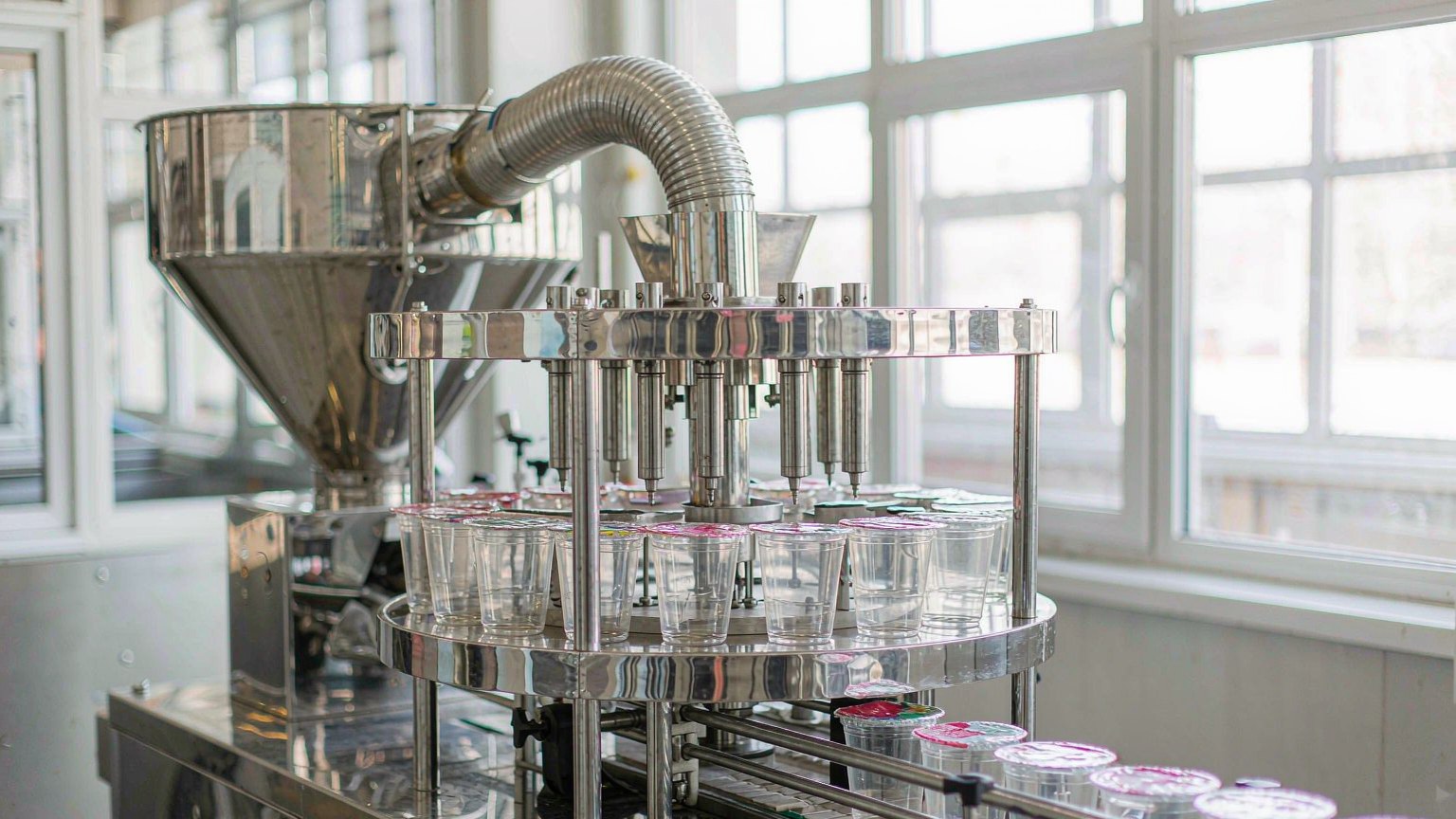
Ice is no longer a by-product of the drinks cabinet. Cold-chain logistics, fresh-food delivery, craft brewing and outdoor events all consume standardised, food-safe ice by the tonne, and that demand has turned ice packing from a manual chore into an automated line. An ice cube filling and sealing machine is what makes that line work: it takes loose ice through dosing, bag forming, sealing and discharge without letting the product turn back into water on the way.
Why ice is harder to pack than powder or liquid
Powder flows, liquid pours. Ice does neither reliably. Cubes are irregular, they stick to each other, and at room temperature a film of condensate appears on every surface within seconds. That moisture is the enemy: it raises humidity inside the bag, weakens the seal and, in the worst case, lets meltwater run into the sealing jaw. Sharp corners add a second problem — drop the ice too hard and it punctures the film.
How the machine is built
Most units share a common architecture: an insulated storage hopper with a low-speed agitator, a conveying section, a dosing station, a bag forming or bag feeding module, a sealing head and a control cabinet. Contact parts are usually food-grade stainless steel or low-temperature engineering plastic. An agitator that runs too fast will shatter the cubes; one that runs too slowly lets them fuse into a single block overnight.
Dosing: volumetric or gravimetric
Volumetric dosing measures a fixed volume with a cup or screw. It is fast and simple, but ice density shifts with temperature and cube geometry, so bag weights drift. Gravimetric dosing weighs each portion dynamically and closes the gate when the target is reached. It is slower per cycle but holds weight far better, which matters whenever the pack carries a declared net weight.
Sealing is where most lines fail
Heat sealing fuses PE and PP films with a heated bar. Ultrasonic sealing generates friction heat in the film itself, producing a narrower, stronger bond — useful on thicker laminates. Either way, a seal is only as good as the bag mouth it meets. Good machines fit an air knife or wiper that clears water and ice chips immediately before the jaws close, and they tie sealing temperature and pressure to film thickness and line speed through the PLC.
Hygiene is not optional
Ice is eaten. Every surface that touches it has to be corrosion-resistant, quick to strip down and easy to sanitise daily. Look for tool-free removal of nozzles, hoppers and sealing jaws, sloped surfaces that do not trap water, and a washdown-rated cabinet. Ice making plants that skip this end up fighting biofilm they can never fully remove.
Where the technology is heading
Two trends stand out. Servo drives let the machine modulate speed to the actual ice load instead of running flat out and wasting energy between cycles. Machine vision, meanwhile, inspects every seal and rejects a bad bag automatically. On a large ice plant these features are no longer luxuries — they are what keeps a high-speed line honest.
For anyone specifying an ice packing line, the deciding questions are unglamorous but they decide everything: how wet is the ice when it arrives, how tight is the weight tolerance, and how fast can the machine be cleaned between shifts.
Need help specifying or upgrading a line?
Send us your product, format and target output per shift. We come back with a station sequence, the tooling list and an indicative price — no obligation.
