

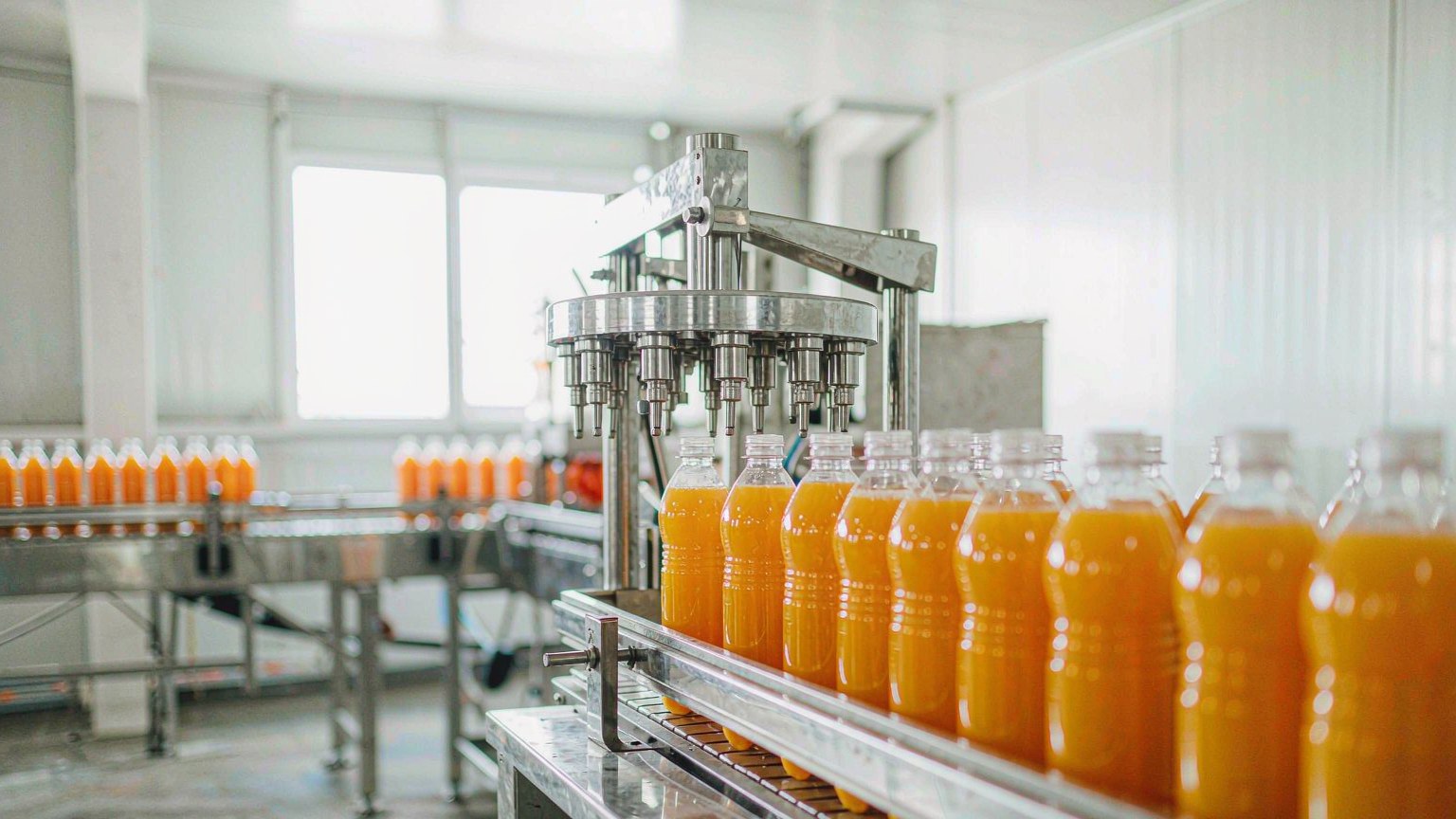
Beverage lines are unforgiving places to get equipment wrong. A filler that is too slow becomes a bottleneck the day demand rises; one that is too fast but fragile turns every shift into a maintenance call. Choosing well is less about the machine and more about matching it to four things you already know: the liquid, the container, the output you actually run, and how much automation you can support.
Start with the liquid
The filling principle is dictated by fluid behaviour, not by preference. Still water and clear juices tolerate gravity filling, where the fill level is set by head pressure and valve timing. Carbonated drinks need isobaric filling so the product never loses carbonation on the way in. Products containing pulp, fibre or fruit pieces call for a piston filler with an agitation system that keeps solids in suspension; without it, the first cups get the solids and the last get water. Oxygen-sensitive juices and functional drinks usually justify nitrogen dosing to displace headspace air.
Then the container
Glass bottle, PET bottle, can, carton or stand-up pouch — each one needs a different filling head, a different conveyor and a different closure. Screw capping, press-on capping, seaming, heat sealing and foil sealing are not interchangeable. Match the machine to the container’s material, shape and neck finish, and confirm that changeover between your formats is realistic rather than a rebuild.
Size for steady state, not for peak
Work out bottles or cups per hour from your current volume plus a realistic three-to-five-year growth figure. Buying for a peak you see twice a year leaves capital sitting idle; buying for today guarantees a second purchase sooner than you would like. Decide the automation level at the same time. A semi-automatic machine with manual loading suits short runs and frequent product changes; a fully automatic line costs far more up front but pays back through labour and consistency on standardised, high-volume products.
Materials, hygiene and serviceability
Product-contact parts should be 316L stainless steel or an equivalent food-grade alloy, and the seal materials should be rated for your cleaning regime. Ask how the machine is cleaned — a CIP circuit that reaches every valve seat is worth more than a polished exterior. Then look at the boring details: how long does a changeover take, can the machine be stripped without tools, and how accessible are the wear parts?
Questions for the supplier
Price should be the last column in your comparison, not the first. Ask for the reference installations nearest to your product, the guaranteed filling accuracy, the spares list and lead times, and how support works when a line stops at 2 a.m. A supplier who answers those clearly is usually the one who also builds a machine that stays in specification.
Treat the purchase as a production decision rather than a procurement one, and the machine you buy is the one you keep.
Need help specifying or upgrading a line?
Send us your product, format and target output per shift. We come back with a station sequence, the tooling list and an indicative price — no obligation.
