

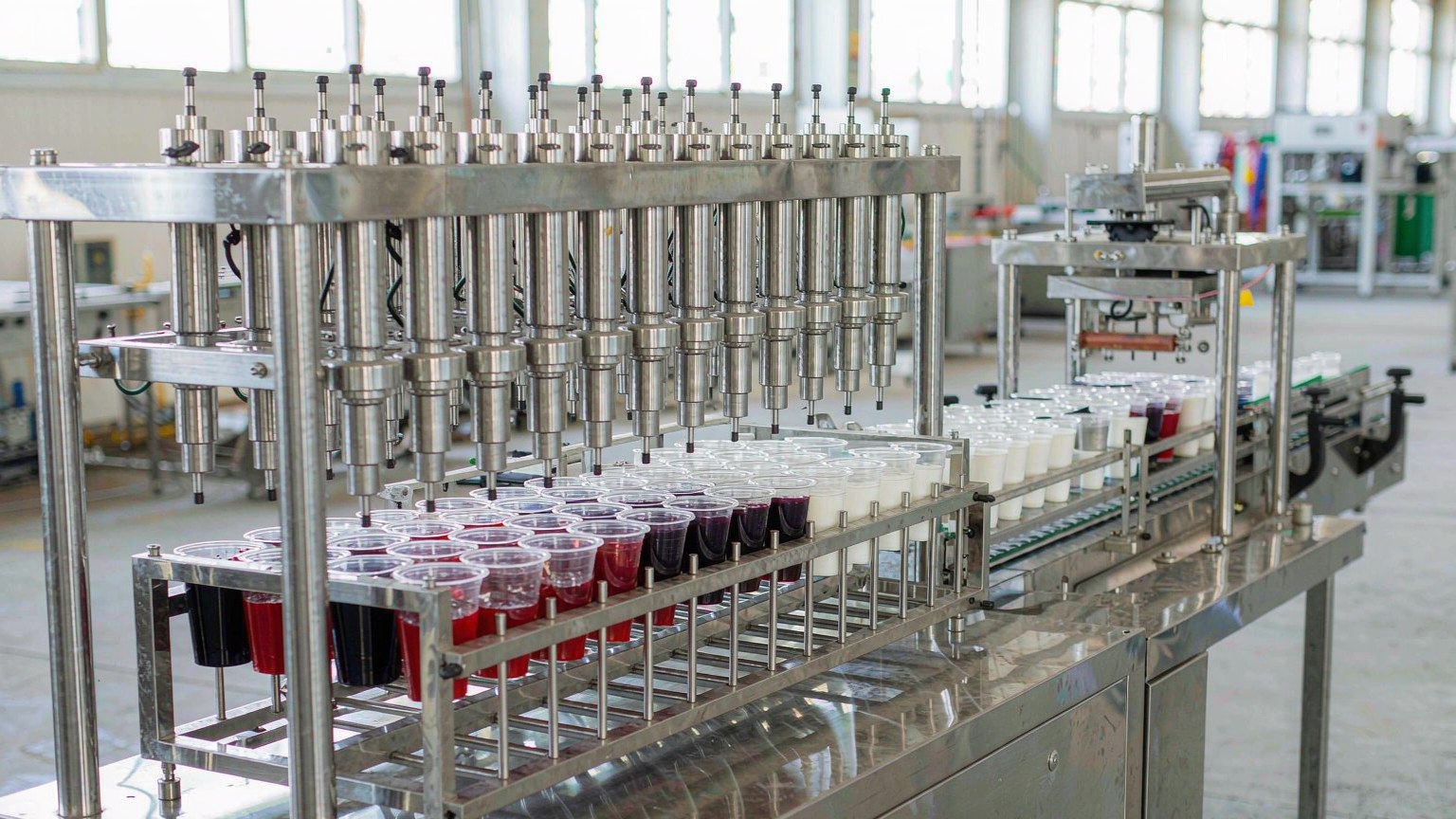
The ice cup business exists because prepared drinks became standardised. A cup of coffee, juice or milk-tea base can now be produced centrally, sealed and shipped, and consumed somewhere else without a barista in between. That shift was not a marketing idea. It was a machinery capability, and it still depends on one.
Throughput is what makes the price possible
A cup filling and sealing machine moves an empty cup through dosing, protective gas flushing and heat sealing as one continuous cycle, without a hand touching the product. Manual filling cannot match that on speed, on dose accuracy or on hygiene, and it cannot produce the volume that distribution requires. Because the machine sets the output of a line and the cost per cup, it decides whether the product can be priced for convenience stores, supermarkets and online channels at all. Scale and cost advantage start here.
Three quality defences
Consistency comes from the metering system: each cup receives the same volume, so the product a customer buys on Monday matches the one they buy on Friday. Shelf life comes from the gas flushing module. Filling the headspace with nitrogen displaces the oxygen that would otherwise oxidise the drink, and it is this step that lets an ice cup travel outside the store that made it — a sealed cup with air above it simply will not survive a distribution chain. Safety comes from the enclosure: the process runs closed, the heat seal forms a physical barrier against the outside, and human contact with the product is removed from the chain. Together these three turn a fresh drink into a packaged good.
It changes the business model on both sides
For foodservice customers, a sealed base cup removes preparation work from the outlet. Staff combine and serve rather than measure, brew, chill and seal, which lowers the skill required and the time per order, and it lets a chain offer the same drink in every location. For retail customers, the sealed cup is the product — its seal and its appearance are what earn shelf space and repeat purchase, and neither can be produced by hand at volume. Standardisation follows automatically: the machine’s parameters become the category’s parameters, so capacity, sealing method and quality expectations converge across the industry.
What to verify before investing
Confirm the machine covers the cup formats and fill volumes actually planned, and ask for a trial on your own product rather than on water — viscosity and particulate content change dosing behaviour. Check that the gas flushing system can be set and verified, since the shelf life target depends on it. Match the seal layer to your film, and confirm cleaning access to every product-contact surface. Finally, size the machine to the volume you intend to reach, not the volume you have today, because a filler that cannot be integrated later limits the whole line.
Need help specifying or upgrading a line?
Send us your product, format and target output per shift. We come back with a station sequence, the tooling list and an indicative price — no obligation.
