

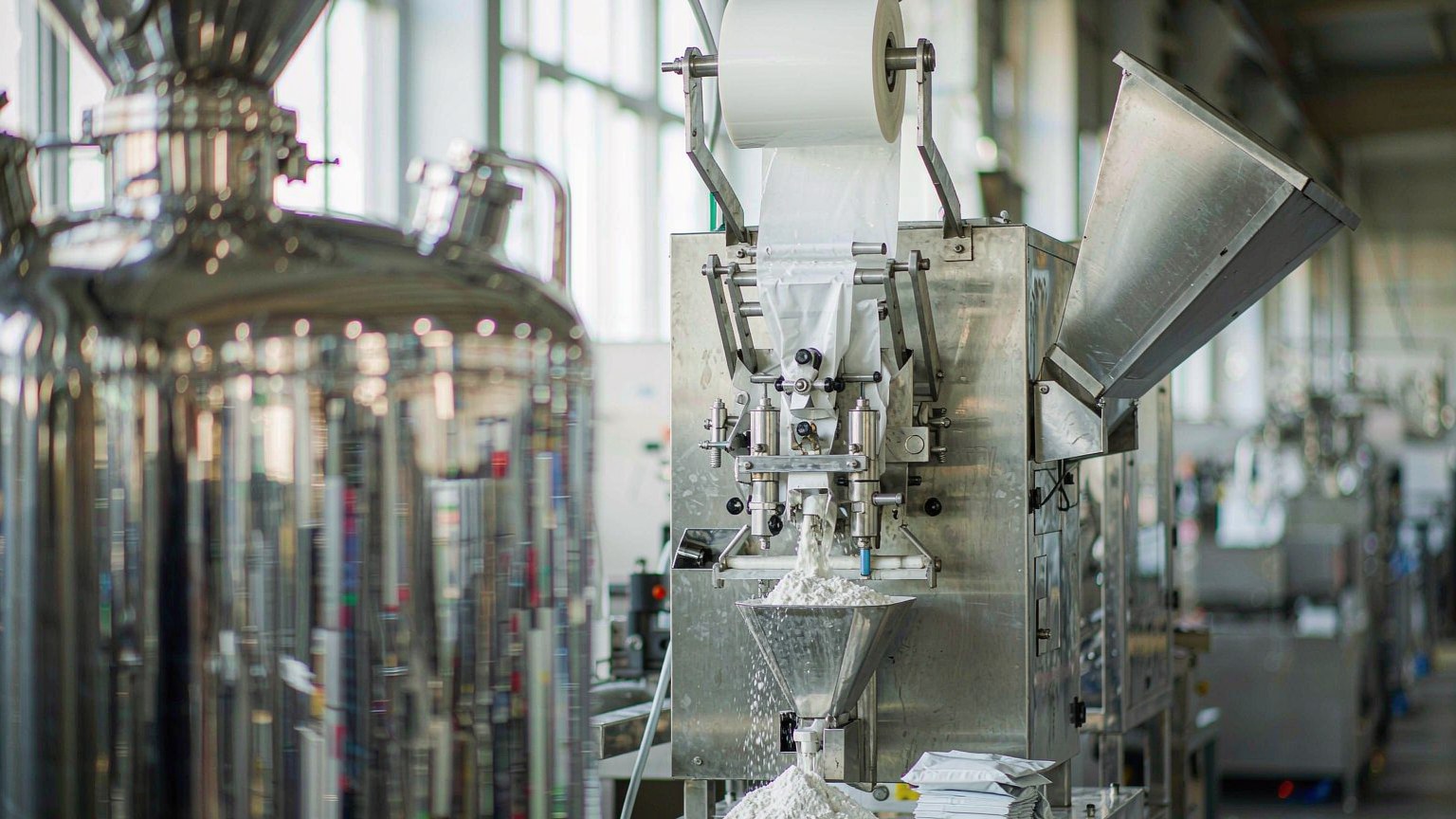
Matcha occupies a distinctive place in tea processing because its value is visible. The deep green colour is a quality signal, and that colour is fragile: it fades under light, degrades with heat, and deteriorates quickly when moisture causes caking. Traditional manual packing made things worse rather than better — airborne dust, inconsistent weights and inconsistent seals, all applied to an expensive product.
The dosing problem and its solution
Ultra-fine powder is difficult to measure: it bridges in hoppers, it holds static charge, and it does not flow predictably. Screw metering, driven by a servo motor, is the standard answer. Powder is advanced by the rotation of the screw, and the number of turns and the rotation speed set the dose, which brings net content consistency to a level that manual weighing cannot approach. The closed hopper and transfer path deliver a second benefit: they suppress the dust that manual filling releases into the workplace, which both improves conditions for operators and reduces the loss of a raw material that is expensive per kilogram. For a producer, that is cost control and workplace improvement from the same design change.
Sealing as the quality line
Because matcha oxidises and absorbs moisture readily, the seal decides the shelf life. Machines use multi-stage temperature-controlled heat sealing paired with high-barrier laminate film to create a reliable barrier. One detail deserves particular attention: a pre-seal air blast that clears fine powder from the sealing zone, because powder trapped in a seal is a channel through which oxygen and moisture enter. Getting that detail right is what allows the product to hold its colour and flavour across the full shelf life, and it is a direct contributor to a brand’s reputation for quality.
Control and hygiene
The machine’s central control is a PLC with a touchscreen interface, which makes filling volume, sealing temperature and running speed digital settings that can be monitored in real time. The practical effect is that changeovers and basic fault-finding require limited training rather than a skilled technician — a meaningful reduction in operating risk for a producer without a large engineering team. Construction in food-grade stainless steel satisfies hygiene requirements and supports the strip-down cleaning needed to prevent carryover between batches, which is what underpins food-safety certification.
The structural effects
The consequences reach beyond the packing hall. Continuous automated operation raises single-machine output by an order of magnitude compared with manual packing, which is what allowed matcha to move from a specialist gift product to an everyday purchase. Standardised filling and sealing removed the random variation between batches, which is the precondition for building a brand rather than selling a commodity. And a reliable, consistent pack travels further and suits more sales channels — supermarkets, e-commerce, export — than an unstable one. Equipment that looks like a production detail has, in this category, been the mechanism by which the category itself grew up.
Need help specifying or upgrading a line?
Send us your product, format and target output per shift. We come back with a station sequence, the tooling list and an indicative price — no obligation.
