

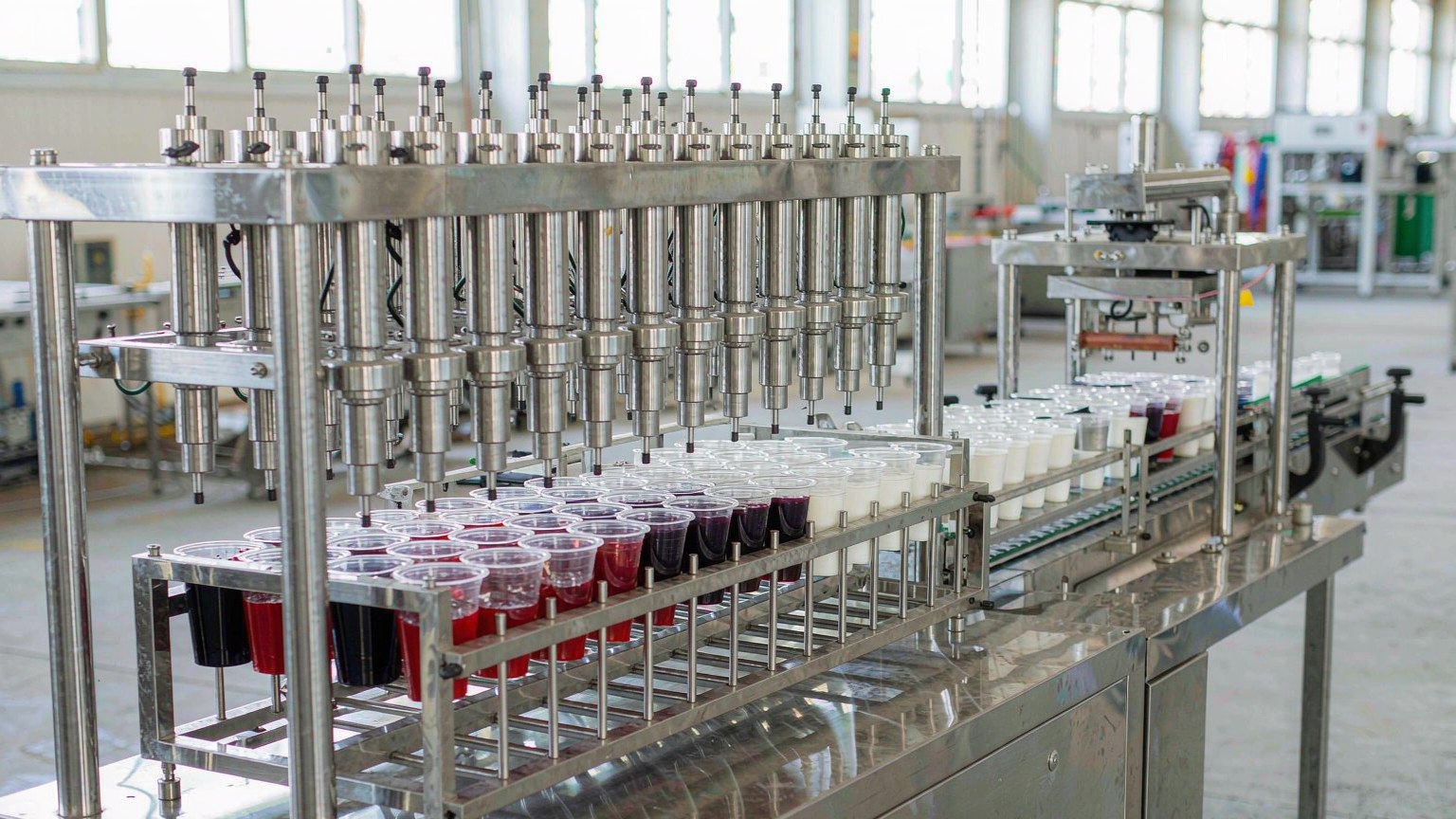
Honey consumption is moving from the family jar toward single-serve formats, and the honey spoon is the most distinctive of them: honey pre-filled into a spoon-shaped container and sealed over the bowl with a foil or laminate lid. The format is popular with consumers and awkward to manufacture, which is why the filling and sealing machine behind it is more specialised than its output suggests.
The filling problem
A spoon container is not a simple cup. It has a handle and a bowl, so the filling system has to locate each container precisely and dose into the bowl without overfilling the rim. Honey makes this harder: it is highly viscous, it resists flow, and it crystallises over time — so the same machine may have to handle a free-flowing product in summer and a semi-solid one in winter. Machines use piston or gear pumps selected for the viscosity range, with dosing accuracy held within about one percent, which is what makes the declared net weight defensible on a small-format, relatively high-value pack.
The sealing problem
Sealing is where the format is won or lost. Honey is strongly hygroscopic: a seal with a gap in it lets the product absorb atmospheric moisture, which accelerates fermentation and crystallisation, and the pack’s whole appeal — a clean, portable portion — collapses. Machines therefore apply carefully controlled heat sealing, with temperature, pressure and dwell matched to the lidding film and the spoon material, so that the lid bonds fully and forms a reliable barrier. Some lines add an in-line leak or seal-integrity check so that defective units are rejected rather than shipped. A properly sealed honey spoon holds its quality for a year and a half or more, which is what makes it viable in retail and e-commerce.
Why the format matters commercially
The consumer-side benefit is easy to see. Honey is inconvenient to take with you, it drips, and it is hard to dose. A sealed spoon removes all three problems: tear the lid, stir or spread, no extra utensil, no sticky bottle neck. That expands honey into occasions it previously did not serve — office tea breaks, travel, a child’s breakfast. On the supply side, the spoon format carries a higher unit value, and an automatic machine makes it economic to produce at scale while holding unit cost within what consumers will pay. Compatibility with different spoon shapes and lid films also lets a brand customise — branded lids, coloured bodies — which is differentiation achieved through packaging rather than through the product.
The honey spoon is a good example of how filling and sealing technology creates a product category rather than just serving one.
Need help specifying or upgrading a line?
Send us your product, format and target output per shift. We come back with a station sequence, the tooling list and an indicative price — no obligation.
