

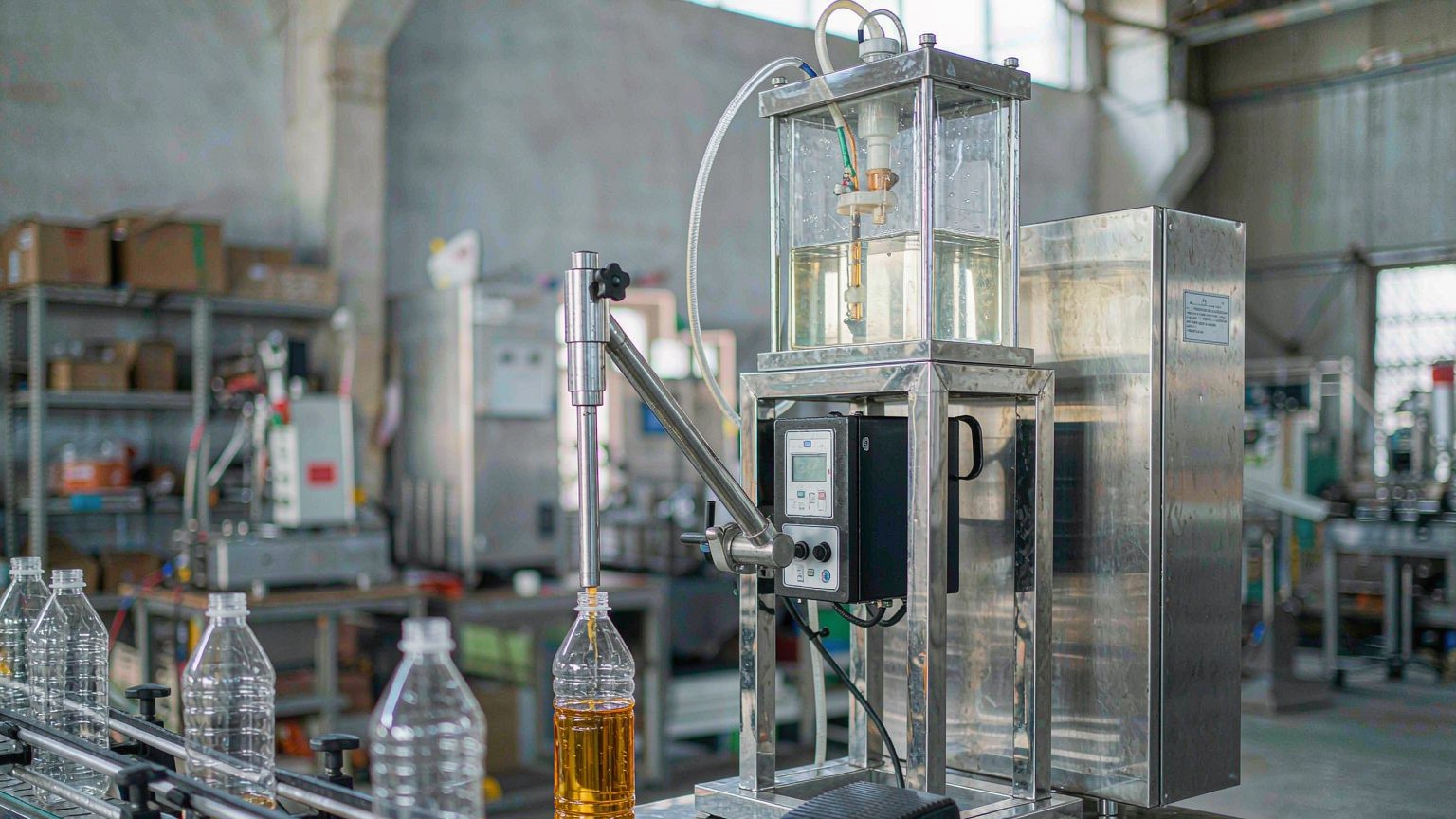
There is a persistent assumption that semi-automatic equipment is a stepping stone to be left behind. In liquid filling that is not how it works. A semi-automatic liquid filling machine remains the correct choice for a large share of real production, and understanding why is useful both for buyers entering the market and for established producers adding a second line.
What they are used for
Semi-automatic fillers handle free-flowing liquids across four sectors. In food they fill drinks, edible oil, soy sauce and vinegar, where drip-free nozzles and food-grade contact materials keep the product clean. In cosmetics they fill toners, fragrances and shampoos, where accuracy protects expensive formulations. In chemicals they fill detergents, agricultural liquids and solvents, where the materials of construction must resist corrosion. In pharmaceuticals they fill liquid medicines and injectable preparations, where accuracy and a design that prevents cross-contamination are essential.
The advantages, ranked by what actually matters
Simplicity comes first. The control system is basic — often a footswitch or a single start button — which means a new operator is productive quickly and the machine does not require a specialist to run. Flexibility comes second: the same unit handles a wide range of products and pack sizes with a setting change rather than a rebuild. Cost comes third, and it is a real advantage — purchase price is materially lower than a fully automatic machine, and maintenance is cheaper because the mechanism is simpler.
Footprint and accuracy
Physical size matters more than it is usually given credit for. Semi-automatic machines are compact enough to fit production areas where a full line would never be installed, which makes them viable for growing businesses operating in rented or constrained premises. Accuracy is not the trade-off people expect: modern semi-automatic fillers use precision metering with fine adjustment, and many add anti-drip design, so fill weights stay consistent and product loss is controlled.
Maintenance and longevity
A simple machine is easy to strip, clean and maintain — which translates into less downtime, not just less maintenance cost. Stainless steel construction resists corrosion and wear, so the service life is long. For a business that changes products often, that combination of quick cleaning and quick re-setting is worth more than a higher throughput figure that cannot be used.
The honest summary: a semi-automatic liquid filler is not a compromise. It is the right machine whenever the constraint is flexibility, capital or floor space rather than volume.
Need help specifying or upgrading a line?
Send us your product, format and target output per shift. We come back with a station sequence, the tooling list and an indicative price — no obligation.
