

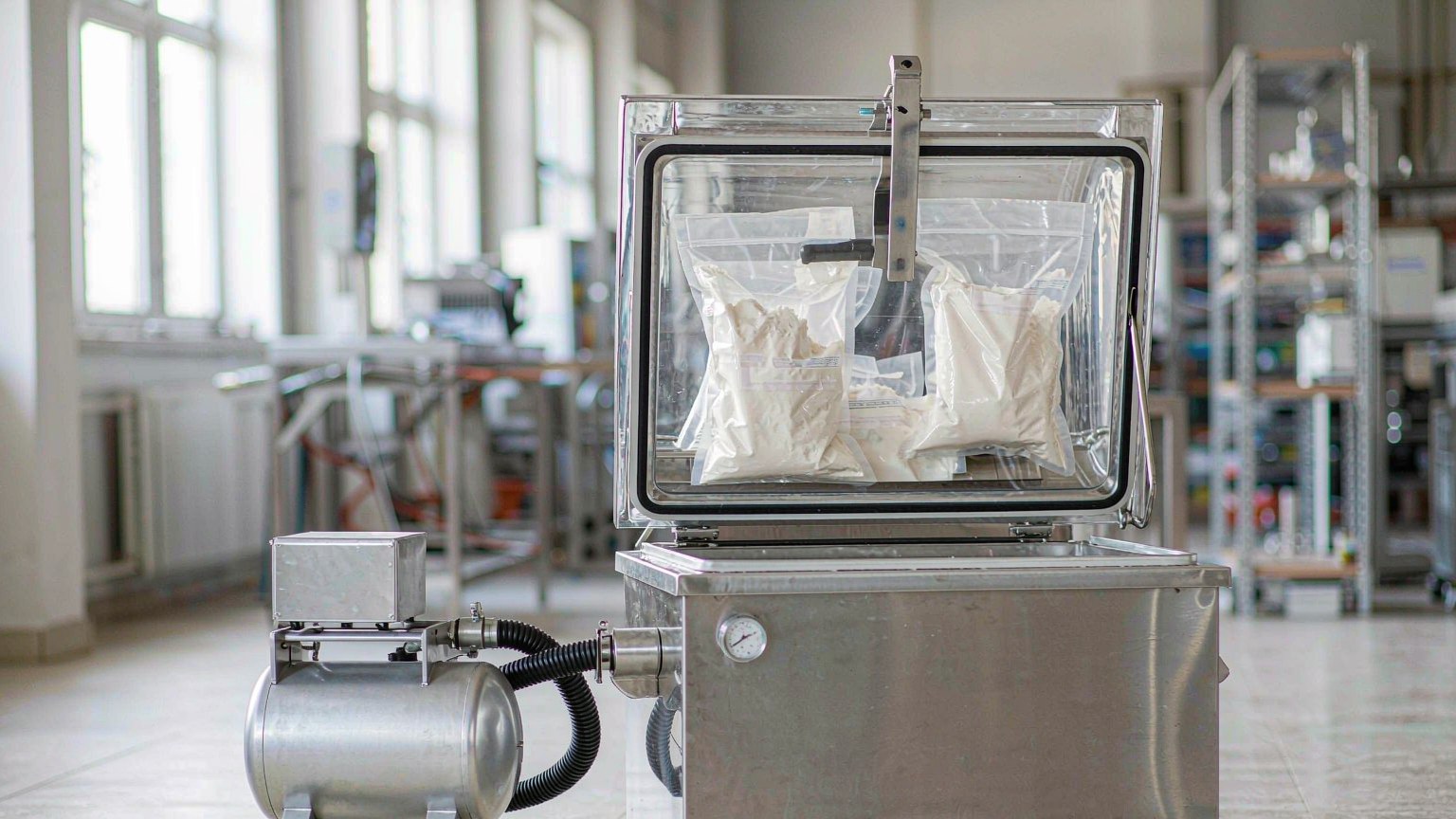
Powder vacuum packaging is a demanding combination: the product is difficult to move, it must not be dispersed into the machinery, and the package has to be evacuated and sealed tightly enough to protect a moisture- and oxygen-sensitive product. Automatic vacuum packaging machines address that combination, and their productivity comes from five specific areas.
1. Speed through automation
Servo-driven machines sequence bag pick-up, metering, filling, vacuum, sealing and discharge without interruption, reaching outputs several times those of semi-automatic equipment. Some designs use a rotary multi-station arrangement that carries out several operations simultaneously, which cuts the cycle time substantially. The metering system matters as much as the mechanics: high-accuracy screw or gravity-feed measurement holds the dose within a fraction of a percent, which reduces rework, and photoelectric sensors monitor powder flow so that a developing blockage is detected before it stops the machine.
2. Vacuum and seal technology
Vacuum level has to be tuned to the powder’s fineness and flow behaviour, because pulling too hard disperses fine powder into the vacuum system. Multi-stage or progressive evacuation addresses this by removing air gradually — which both protects the product and shortens the cycle compared with a single hard pull. Sealing uses impulse heat sealing with adaptive temperature and pressure, which produces a reliable seal while shortening the cooling time; machines fitted with dual sealing bars can alternate between them to maintain continuous production rather than pausing for each seal to cool.
3. Control and fault prediction
A PLC with an HMI allows packaging parameter templates to be stored — one for milk powder, another for a toner or additive — so that switching products takes seconds rather than a re-setup. The interface reports output and fault codes in real time, which shortens diagnosis. Connected monitoring goes further: sensors collect vibration and temperature data so that the condition of critical components, a vacuum pump being the obvious example, can be tracked and maintenance scheduled before failure rather than after it. That is what converts unplanned downtime into planned downtime.
4. Flexibility
Modular design supports quick format changes — a stand-up pouch to a four-side-seal bag, for instance — in a matter of minutes, which is what makes small-batch, multi-variant production economic. Compatibility can also be extended through options such as nitrogen flushing or gas packaging, so a product requiring moisture or oxidation protection does not require a different machine.
5. Energy and labour
Variable-frequency drives reduce standby energy consumption compared with fixed-speed machines, and integrated dust recovery reduces the loss of product that would otherwise be extracted and discarded. On the labour side, one automatic machine typically replaces several manual stations, requiring only one person for inspection and replenishment — which in most plants is the largest single contribution to the reduction in cost per pack. Together, these five areas are what make an automatic powder vacuum packaging machine a productivity investment rather than simply a faster machine.
Need help specifying or upgrading a line?
Send us your product, format and target output per shift. We come back with a station sequence, the tooling list and an indicative price — no obligation.
