

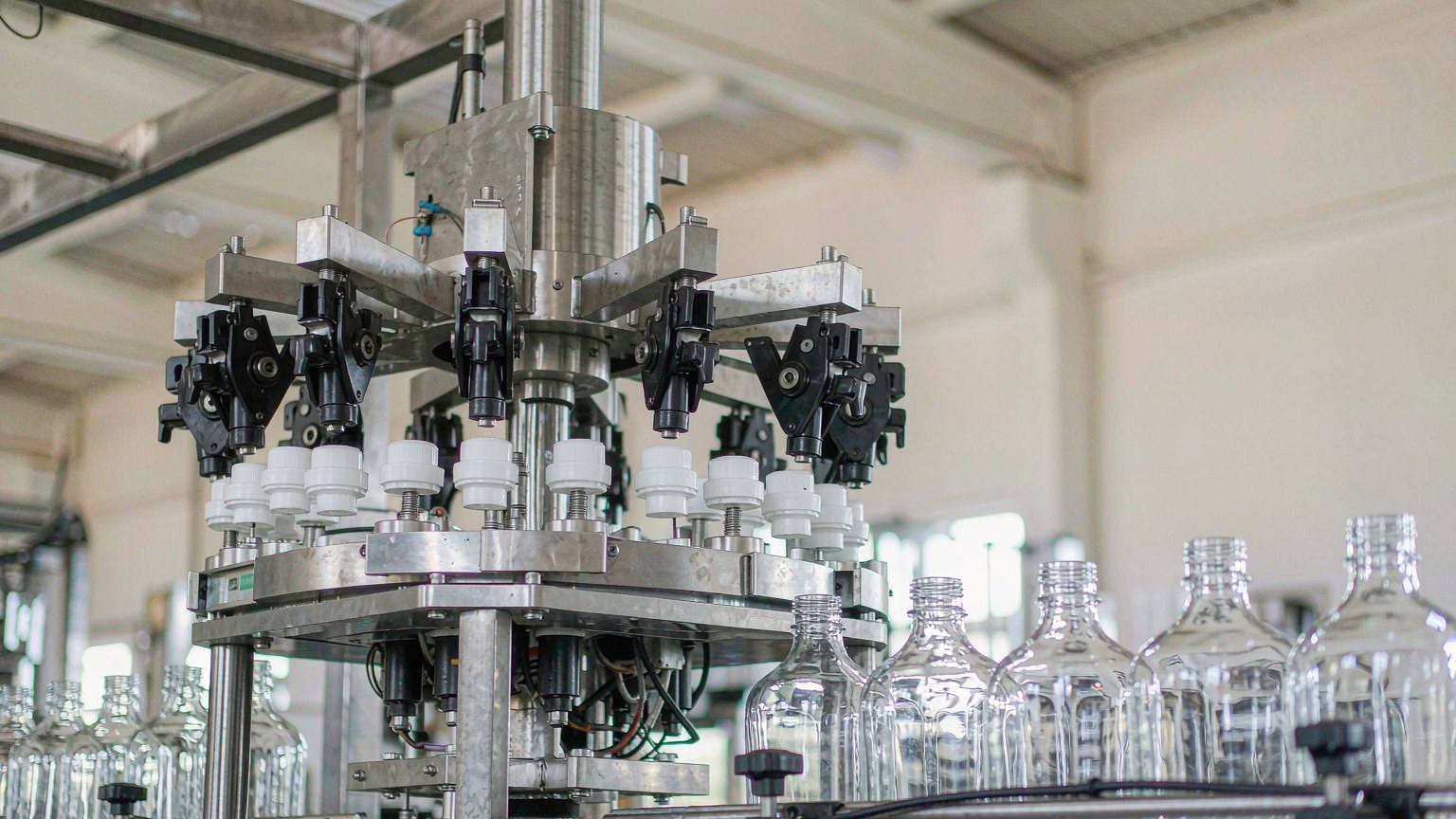
Liquid filling and sealing machines sit in food, beverage, pharmaceutical and personal care plants because every one of them has to put a measured quantity of a flowable product into a container and close it reliably. The machines look similar across those industries; what differs is the specification, and getting the specification right is the entire task.
The machine, in outline
Four subsystems do the work: the filling system, the sealing system, the drive and conveying system, and the control system, all mounted on a common frame. The filling system selects its method from the product — atmospheric or gravity filling for water and juice, vacuum and pressure filling for other products, metering pump filling for precise doses — while the sealing system selects its method from the container: screw capping, press-on capping, crimping, heat sealing or ultrasonic sealing. A PLC coordinates the sequence from container infeed through filling and sealing to discharge.
Choose the level of automation deliberately
Semi-automatic machines require an operator to load and remove containers and suit small batches and frequent product changes — pilot plants, laboratories, short-run speciality production. Fully automatic machines convey containers through each station without intervention and reach outputs from tens to hundreds of containers per minute, which is the requirement for large-scale production. The physical layout matters too: inline machines are simpler and easier to adjust, while rotary machines run faster and more smoothly and are the usual choice for high-output beverage and pharmaceutical lines.
Precision and hygiene
Filling accuracy should be quoted as a tolerance — a fraction of a percent is achievable on modern equipment — and it protects both product cost and regulatory compliance. Wetted parts should be stainless steel with food-grade seals, easy to strip and sanitise. Useful reliability features include drip-free nozzles, a no-container-no-fill interlock so the machine cannot discharge into an empty station, and overload protection. Where sterility is required, as with milk or injectables, the machine can be supplied with UV or steam sterilisation integrated into an enclosed filling zone.
Matching the machine to the product
Viscous products need pressure or piston filling; carbonated products need isobaric filling to avoid foaming and gas loss; particulate products need a filler that will not bridge or block. Container material dictates the closure: plastic bottles take screw caps, glass can be crimped or press-capped, and flexible packaging is heat sealed. Line speed must match whatever is upstream and downstream — a filler that outruns the labeller has simply moved the bottleneck.
Maintenance is part of the specification
Check filling valves for blockage and wear, verify sealing head alignment, watch for conveyor tracking drift, lubricate moving parts and clean product lines and tanks before residue can set. Replace seals on metering pumps and cylinders on schedule. Two faults account for most lost production: inaccurate fills, usually from a leaking valve or a loose metering linkage, and weak seals, usually from insufficient temperature, pressure or dwell. Both are quick to correct if they are being looked for.
Need help specifying or upgrading a line?
Send us your product, format and target output per shift. We come back with a station sequence, the tooling list and an indicative price — no obligation.
