

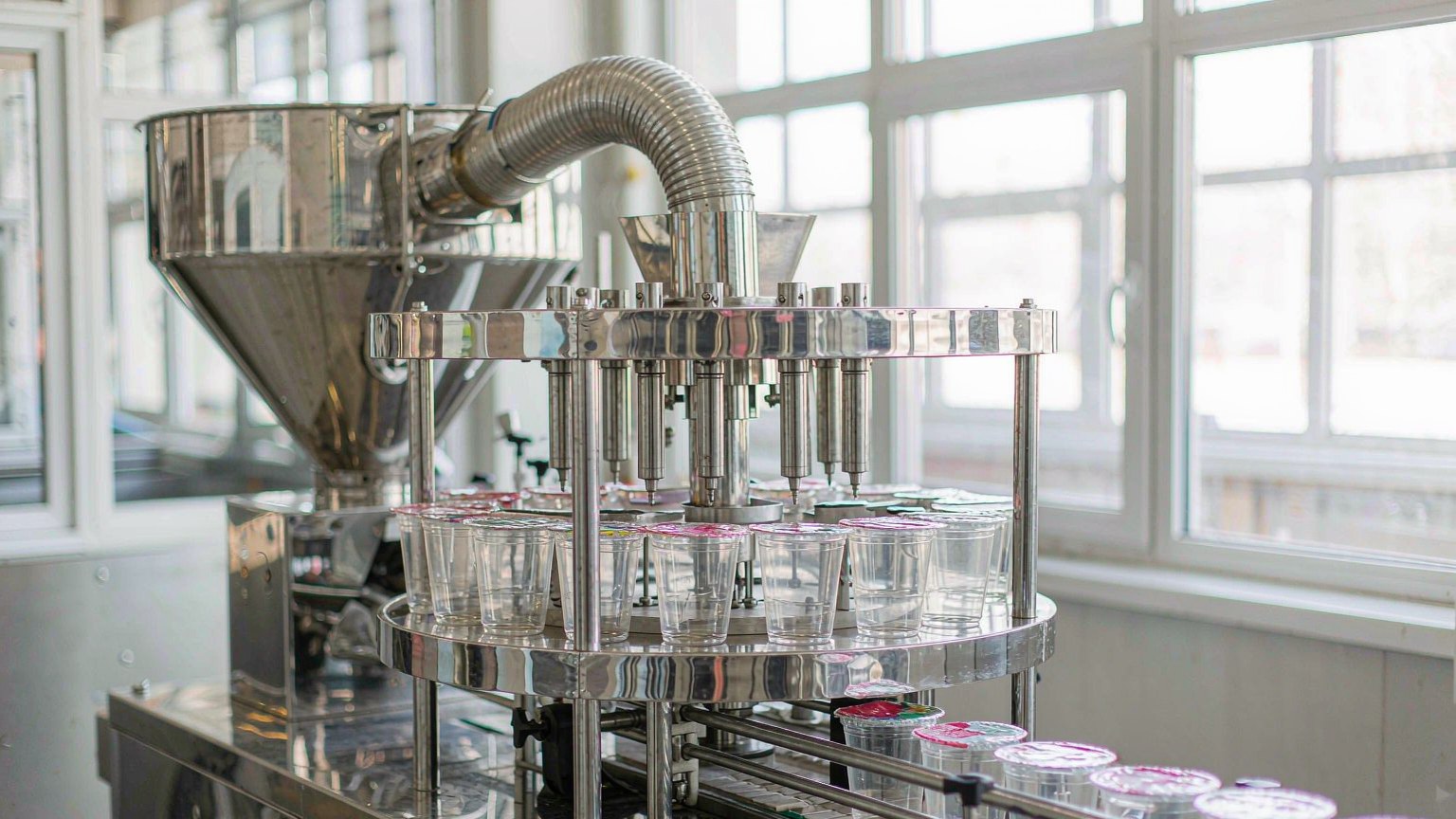
Pet food has followed human food in one important respect: the market has moved toward smaller, more frequent portions and toward products that make a health claim. Cans and large bags no longer cover the category. Wet food, meat pastes and nutritional gels are increasingly packed in cups and trays, and that shift was enabled by cup and tray filling and sealing equipment.
From manual packing to a controlled process
Before this equipment became common, wet pet food was filled by hand or on semi-automatic machines, which limited both output and consistency. An automatic line removes the operator from the filling sequence entirely. A rotary multi-station machine can weigh, fill, vacuum, flush with nitrogen and seal in one pass, handling large volumes per minute. The result is that a brand can respond to a spike in demand without recruiting, and can hold a consistent portion size across a whole production run.
Safety and shelf life
Pet owners read labels and care about safety, and pet food is a biologically demanding product. A closed filling environment reduces the opportunity for contamination from operators and surroundings. Vacuum and nitrogen flushing remove oxygen from the headspace, which suppresses microbial growth and protects fats from oxidising, extending shelf life and stabilising flavour and nutritional content. That capability is precisely what made premium functional products — prescription diets, probiotic supplements, therapeutic pastes — commercially viable at scale rather than as small-batch specialities.
Packaging that fits how people actually feed their pets
Cup and tray formats suit contemporary feeding habits. They are portable, easy to open and reseal, and they portion food without measuring. Just as importantly, flexible filling equipment lets a brand vary cup size and fill volume to create a product range: portion sizes for different breeds and body weights, flavour combinations sold as multipacks, and formats aimed at different life stages. Without flexible filling, that kind of segmentation would require multiple production lines and would not be economic.
Sustainability, in a category under scrutiny
Pet packaging is attracting attention for its environmental footprint, and equipment has moved to respond. Newer machines accommodate degradable cups and paper-plastic composite trays, which cut the plastic burden of the format. Accurate filling reduces product waste at the same time, and the two together satisfy both the commercial case for leaner production and the reputational case for lower environmental impact.
Cup and tray filling equipment has done more for pet food than improve packaging efficiency. It has given the category the ability to be premium, functional and varied — which is exactly where its growth has come from.
Need help specifying or upgrading a line?
Send us your product, format and target output per shift. We come back with a station sequence, the tooling list and an indicative price — no obligation.
