

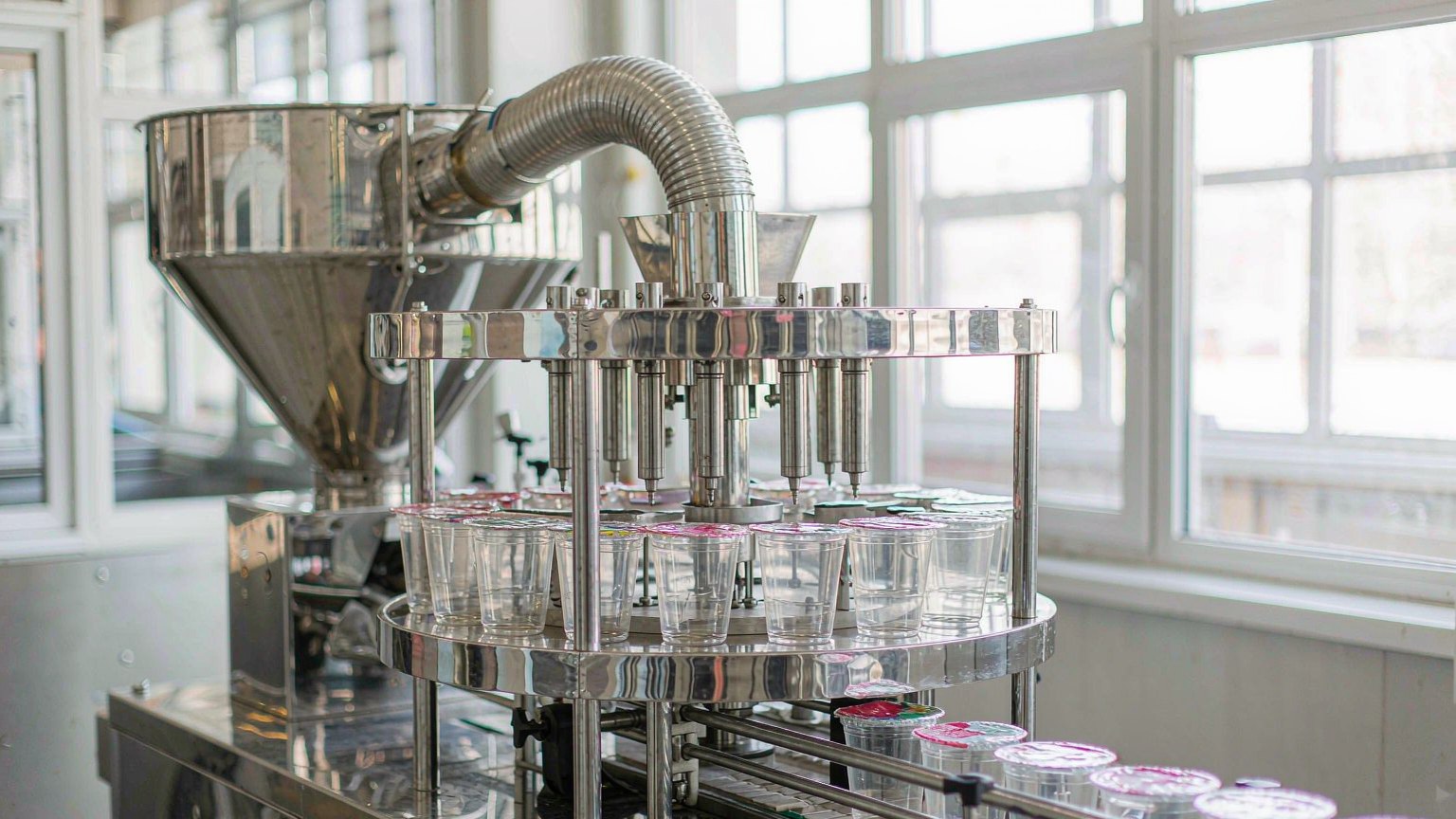
Yogurt is a semi-fluid product with a texture that consumers notice immediately. It may be set or stirred, plain or with fruit, cereal or sauce inclusions, and it is filled into plastic cups, glass jars or cartons. A filling and sealing machine for yogurt therefore has to satisfy two requirements at once: dose accurately, and avoid damaging the very structure that makes the product appealing.
The sequence
Containers are conveyed into a clean or aseptic filling area, purged with clean air to remove any foreign matter, and positioned under the filling station. Filling is the technically sensitive step. Yogurts of different viscosity — from set types to stirred types — are handled by volumetric filling, typically using a piston or a screw arrangement, which holds the weight or volume of each cup consistent. Where the product contains fruit pieces, the design of the filling head and the control system becomes critical: the objective is to move the inclusions without shearing them, so that the fruit arrives intact and evenly distributed rather than crushed and concentrated in some cups.
Layered products and inclusion stations
More complex lines integrate additional dosing stations. After the plain yogurt base is filled, a separate precision injector can add jam, fruit pieces or cereal to the bottom of the cup or into the middle of the fill, which is how layered and fruit-on-the-bottom products are made. The inclusion station is a second filling problem in its own right — it must dose accurately at a small volume while continuing to protect the integrity of the pieces.
Sealing and coding
After filling, the machine picks and places the lid — foil membrane, plastic lid or both — and seals it by heat pressing, ultrasonic welding or mechanical capping. The seal has a two-sided requirement: it must be entirely airtight so the product does not spoil within its shelf life, and it must be possible for a consumer to open without difficulty. Coding is then applied to the cup or lid with the production date and batch number, and the finished cup is discharged for chilling and secondary packing.
What the machine is really doing
Describing a yogurt filler as a filling machine understates it. It operates in a fully enclosed clean or aseptic environment, which is what prevents recontamination and provides the food safety guarantee. Its dosing control is what protects the producer’s cost base by holding the declared quantity. And its flexibility — different viscosities, inclusion types and pack formats, changeable without a new line — is what makes the constant stream of new yogurt variants commercially viable. From a smooth plain yogurt to a fruit-layered cup, the product’s consistency and appeal depend on decisions made at the filling head.
Need help specifying or upgrading a line?
Send us your product, format and target output per shift. We come back with a station sequence, the tooling list and an indicative price — no obligation.
