

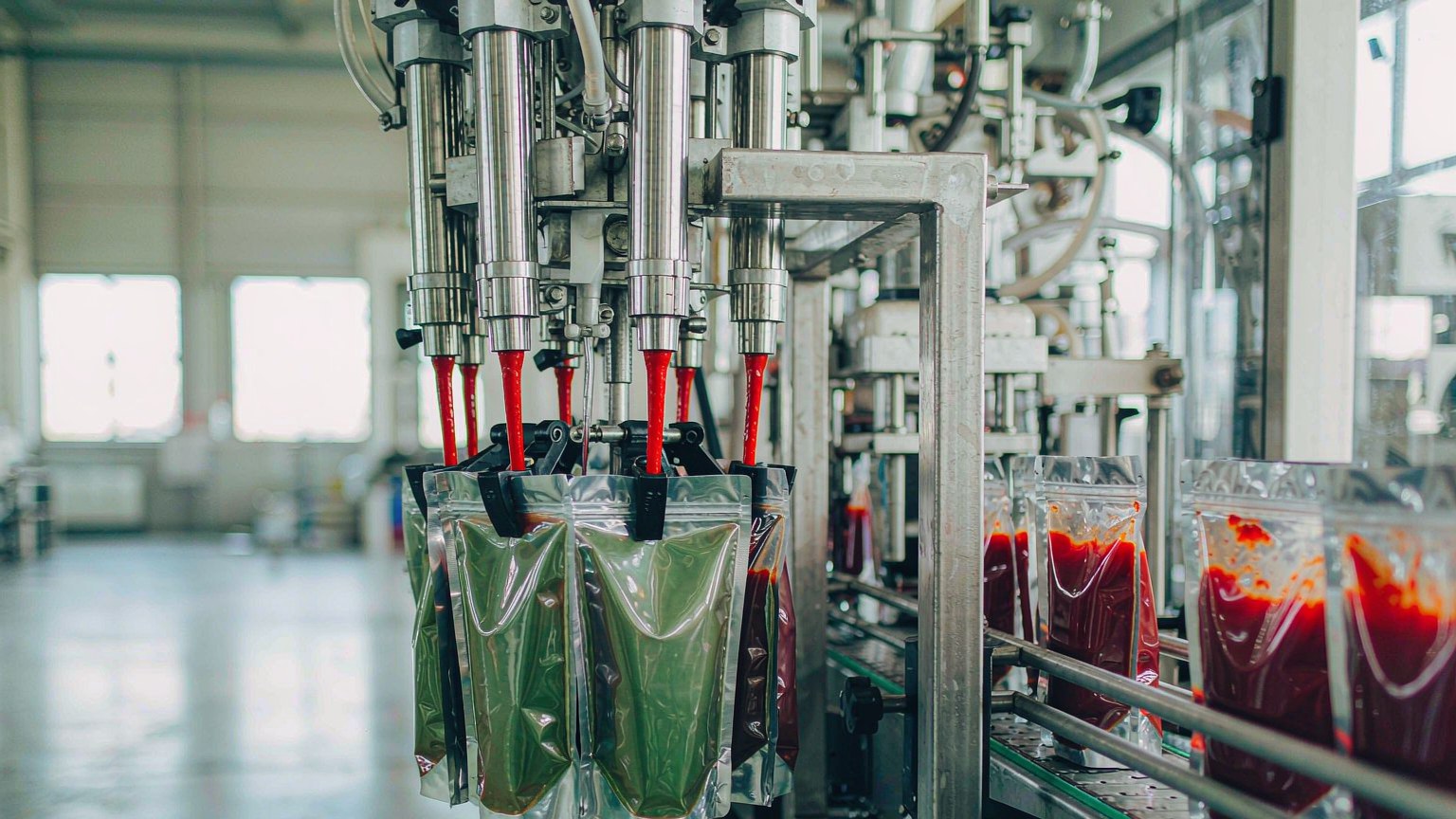
The stand-up pouch is one of the most successful packaging formats of the last thirty years: it stands, it pours, it uses less material than a rigid container and it prints beautifully. It is also less forgiving to make than it looks. Production problems concentrate in four areas, and each one has a diagnostic path.
1. Leakage
Leaks are a materials problem and a sealing problem, and usually both. On the material side, the laminate has to be specified for the job: the surface tension of the treated face needs to be high enough for the adhesive and ink to bond, typically above 38 dyn/cm, while the heat-seal layer needs good low-temperature sealing behaviour and a lower surface tension on its sealing face. The adhesive should have high solids and low viscosity, and the ink and solvent must be compatible with the structure. On the machine side, seal strength depends on temperature, pressure and dwell being set to the actual film, not to a generic recipe. Verify by inflating a sealed pouch with air, sealing the end, immersing it in water and squeezing — bubbles mean a leak. The four-layer seal at the bottom of a stand-up pouch is the most critical joint in the whole pack and deserves its own parameter trial.
2. Waviness and lack of flatness
A pouch that will not lie flat looks second-hand on the shelf. The machine causes are well understood: sealing temperature too high, pressure too high or dwell too long will shrink and distort the laminate, while inadequate cooling leaves internal stress in the film that shows up as wrinkles. The fix is to bring the parameters back into range and, critically, to confirm that the cooling circuit is working properly — a cooling problem mimics a temperature problem and will not respond to parameter changes alone.
3. Asymmetric bottom seals
Asymmetry is both a cosmetic and a functional defect, because an uneven bottom seal is usually a weaker one. The causes are mechanical: uneven laminate thickness or wavy edges, insufficient tension on the dancer rollers, poorly controlled gusset tension, or a roller that is not running true. Correction means adjusting dancer tension, checking and re-aligning the guide rollers, reducing unwind tension where it is excessive, and adding dwell time at the sealing station. Where asymmetry persists, look at registration tracking, unwind behaviour, eye-mark design, roller balance and drive synchronisation — the answer is usually specific to the film and machine combination rather than general.
4. Dimensional error
Pouches that are consistently the wrong length produce customer complaints and returns. The usual culprits are the length-setting system on the bag maker drifting, the registration photocell tracking unreliably, or an operator-side factor such as incorrect film tension or insufficient pressure on the pull rollers. Bring the length system back to its datum, verify the eye-mark detection, then reset film tension and roller pressures. Running the machine more slowly while the correction is made is not a compromise; it is the fastest way to find the setting that holds.
The common thread across all four defects is that the fixing happens in a defined order — material, then parameters, then mechanics. Working in that order removes the guesswork.
Need help specifying or upgrading a line?
Send us your product, format and target output per shift. We come back with a station sequence, the tooling list and an indicative price — no obligation.
