

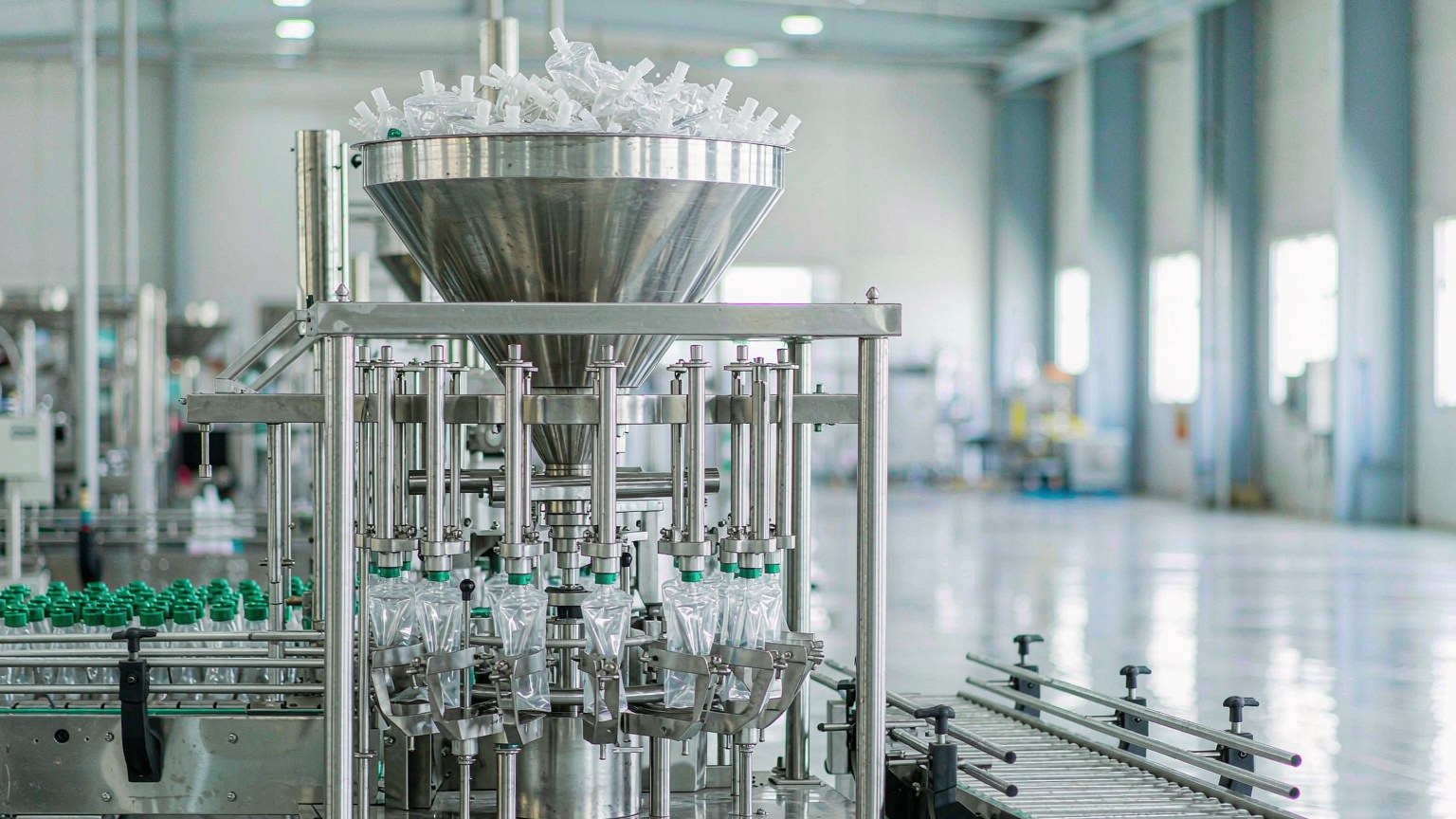
Stand-up pouches with a welded spout have become one of the most successful liquid formats in food, beverage and household products. They stand on the shelf, they pour, and once fitted with a spout and cap they open and close like a bottle. The machine that fills and caps them differs from a cup or bottle filler in interesting ways, largely because the container is flexible and the closure is small.
The five mechanisms
The first is bag feeding, which places each pouch onto a station on the carousel. More advanced designs use a rod-less transfer arrangement, which improves positional stability and therefore the reliability of everything downstream. The second is filling. Because pouch products range from thin liquids to thick pastes, the filling system is matched to the product: a piston pump for viscous material, a peristaltic pump for fluids, with the option of gas flushing where the product benefits from it. Filling is linked to a metering device that sets the actual volume, and products that foam — beer being the obvious example — need a dedicated anti-foam provision.
The third mechanism presents the caps: they are unscrambled, oriented and delivered to the spout. The fourth applies the cap and tightens it, and torque control here is what determines whether the pack leaks or the consumer cannot open it. The fifth discharges the finished pouch, either passively as the carousel rotates or with an active cylinder.
How the machine is laid out
The typical architecture is a rotating inner carousel mounted on a fixed main frame. Around the carousel’s circumference are evenly spaced U-shaped pockets that hold the pouches. The metering device, filling station and capping station are fixed to the main frame, as are the bag feeding and discharge mechanisms. Filling takes place while the carousel is stationary; the carousel indexes, filling pauses, and the cycle repeats. This arrangement has a direct consequence for sizing: the diameter of the carousel determines how many filling stations can be fitted around it. A carousel of about 1.2 metres, for instance, generally accommodates four to five filling stations, which translates into a throughput in the region of five thousand pouches per hour.
Why the format keeps growing
The spout pouch solves a specific problem: a pouch on its own is awkward to store and difficult to pour from once opened. Adding a spout and cap gives the pack the function of a bottle while keeping the material efficiency and light weight of a pouch. That combination is behind the format’s sustained growth, and it is why the filling and capping machine — rather than the pouch itself — is the enabling technology.
Need help specifying or upgrading a line?
Send us your product, format and target output per shift. We come back with a station sequence, the tooling list and an indicative price — no obligation.
