

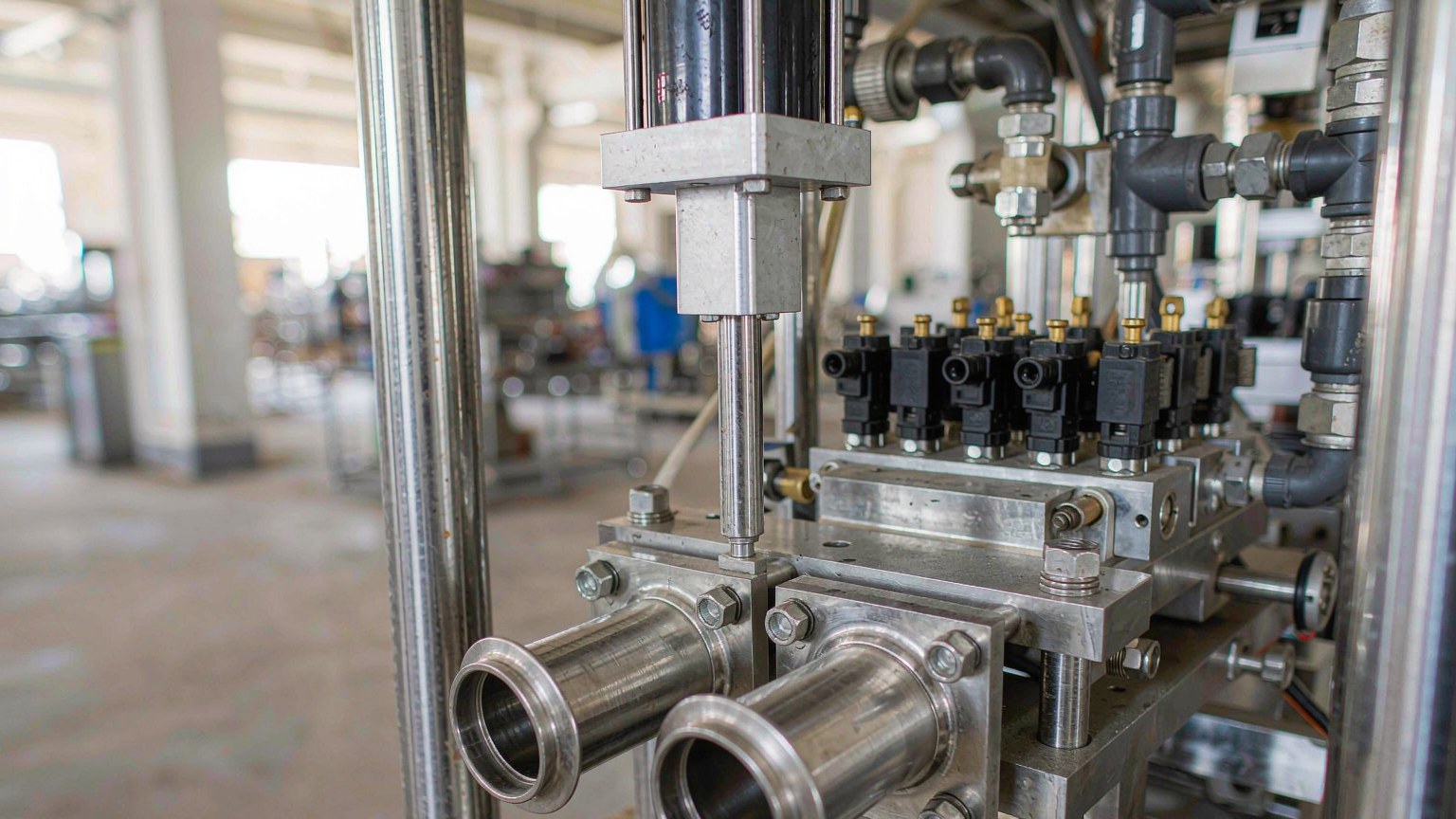
Filling and sealing machines appear in food, beverage, cosmetics and pharmaceutical plants, and while their configurations differ widely, the underlying architecture is consistent. The machine is built from four assemblies, and the performance of the whole can be understood by understanding what each one is responsible for.
The filling system
This is the core of the machine, and its job is to deliver an accurate quantity of product into the container. It comprises the filling head, the filling valve and the pump. The head moves to align with the container opening; the valve controls product flow; the pump supplies product to the head. The valve design matters a great deal — a diaphragm-type valve, for example, gives good control over flow rate and therefore over the delivered quantity, which is why it is common in machines where dosing accuracy is critical.
The sealing system
The sealing system closes the filled container. It consists of the sealing head, the sealing die and the closure or lid. The head moves into position over the container mouth and applies the closure by heat sealing, cold sealing or another method matched to the packaging material. Its function is to make the pack airtight, which is what prevents leakage and protects the product from contamination — and, in packaging that needs barrier performance, from oxygen and moisture as well.
The control system
Control is a PLC with a touchscreen interface. The PLC carries the sequence logic for each step, which is what allows filling and sealing to proceed automatically rather than through operator action; the interface provides parameter setting, recipe recall and fault reporting. The practical significance of the control system is that it determines how quickly a machine can change products and how much skill an operator needs to run it — which is often a bigger factor in the machine’s real cost of ownership than its purchase price.
The electrical and pneumatic system
This provides power and actuation. Motors drive the mechanical components, pneumatic elements produce the linear movements of filling and sealing heads and of container handling, and sensors monitor machine state and product flow so that the control system can act on what is actually happening. Sensor reliability is a frequent determinant of overall machine reliability, and sensor cleanliness a frequent determinant of fill accuracy — a point that maintenance routines often underweight.
Why the breakdown matters
Looking at the machine as four systems makes specification and troubleshooting far more tractable. A fill weight problem is a filling-system question. A leaking pack is a sealing-system question. A changeover problem is usually a controls question. And an intermittent fault that appears and disappears is most often electrical or pneumatic. The machine is complex in detail but simple in structure.
Need help specifying or upgrading a line?
Send us your product, format and target output per shift. We come back with a station sequence, the tooling list and an indicative price — no obligation.
