

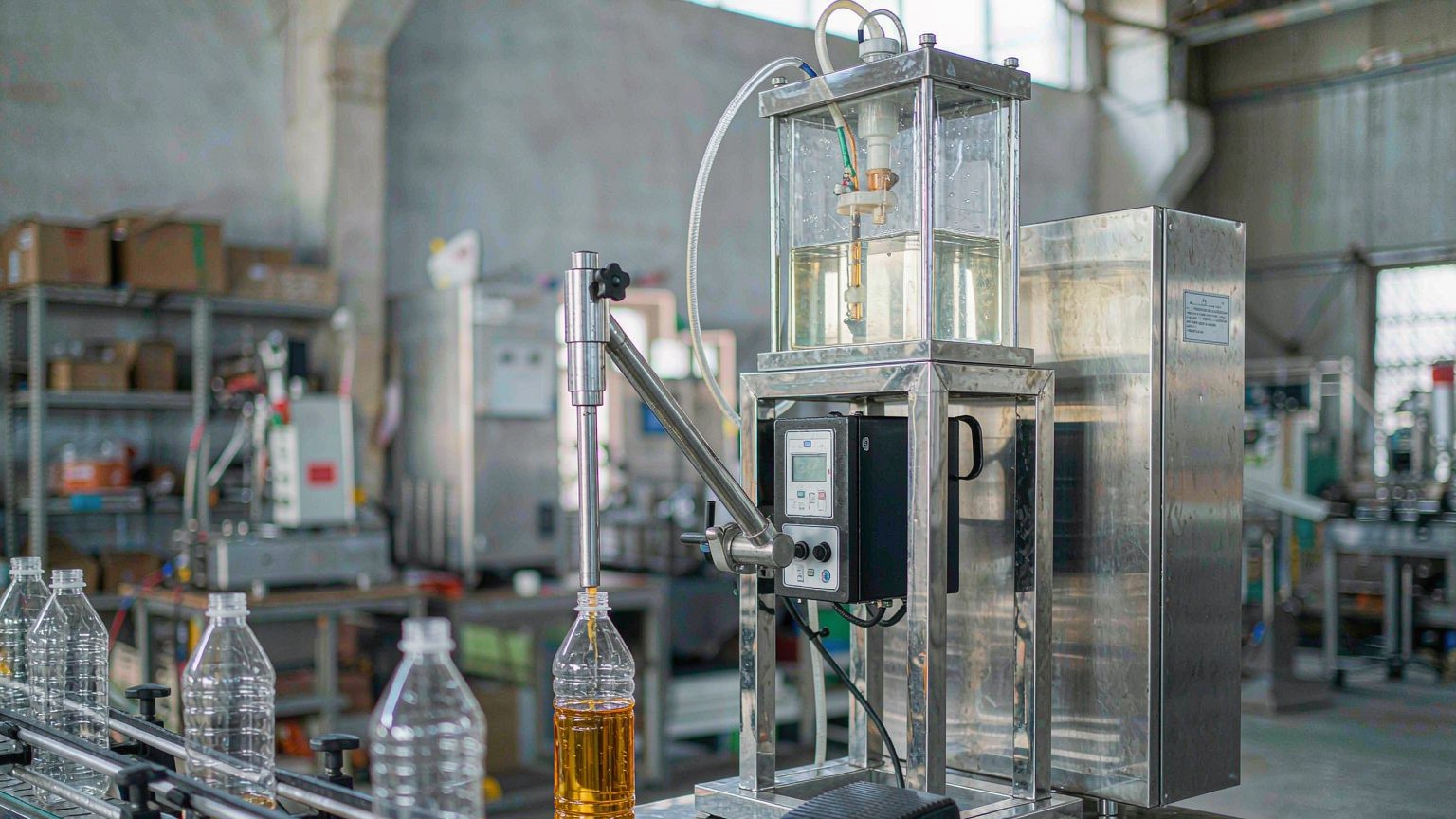
An automatic liquid quantitative filling machine performs three tasks in sequence without an operator: it fills a container, measures the quantity delivered, and closes the pack. Its value lies in doing so consistently across a long production run, which is what makes packaged liquid products both compliant and predictable in cost.
How it works
Liquid is transferred from a tank or trough to the filling head by a pump or by pressure differential. The filling control system then determines the dose: a sensor or metering device monitors what has been delivered, and the filling head closes automatically when the preset quantity is reached, at which point the filled container moves on to sealing or labelling. Internally, the machine uses a flow meter or a volumetric metering arrangement to monitor fill volume continuously, and higher-specification machines add self-calibration that adjusts dosing automatically for changes in the product’s viscosity or density. That last feature matters more than it appears: a product that thickens as it cools, or varies between batches, will drift out of specification on a machine without automatic compensation.
What it offers
Throughput is the first benefit: the machine fills far faster than manual or semi-automatic dosing, which shortens the time needed per unit and raises the line’s overall capacity. Accuracy is the second and the most economically significant — the dosage control system holds each container to the set quantity, so neither short fills nor overfills occur, and both forms of waste are eliminated. Labour is the third: the process runs with almost no manual intervention, which reduces the human cost and removes the error that accompanies manual dosing. Versatility is the fourth: the same machine handles viscous liquids, thin liquids and corrosive liquids, which is what makes it useful across food, beverage, pharmaceutical and chemical production. And hygiene is the fifth, since machines intended for food and pharmaceutical work are built in stainless steel or corrosion-resistant material, support automatic cleaning, and meet the standards the industry requires.
Where the technology is heading
Three directions are visible. Automation will deepen, with more of the setup and adjustment handled by the control system rather than the operator. Closing and labelling will be integrated into the same machine, so that a single unit performs the whole sequence from filling to finished pack. And effective capacity will keep rising through faster mechanical cycles and better control, while energy consumption per pack falls. For a producer, the practical consequence is that the specification worth paying for is the one that matches the actual product range — accuracy, compatibility and cleanability — rather than the highest headline speed available.
Need help specifying or upgrading a line?
Send us your product, format and target output per shift. We come back with a station sequence, the tooling list and an indicative price — no obligation.
