

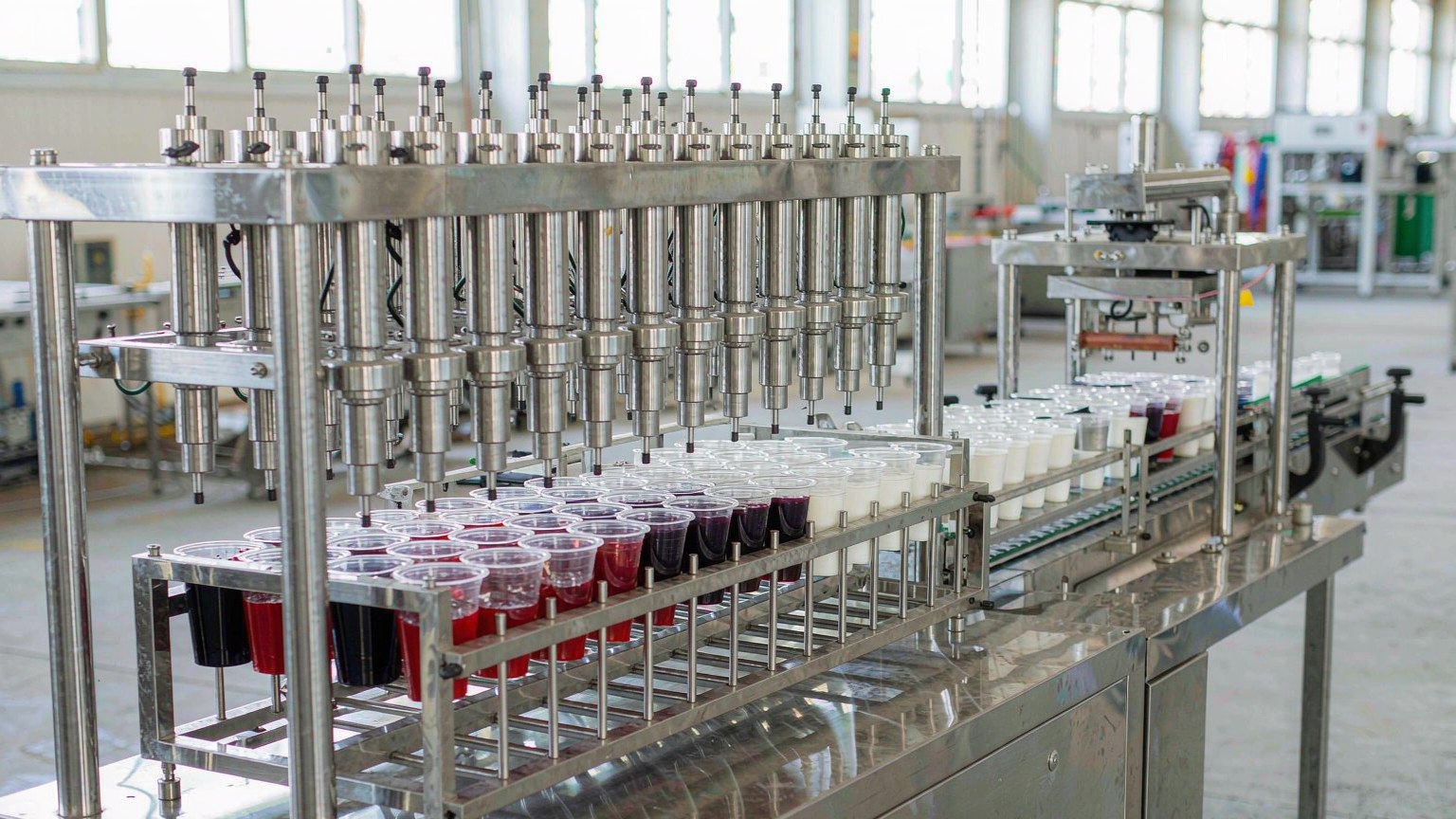
Sauce, condiment and honey products are increasingly sold in cups, boxes, bowls and trays rather than bottles, and the reason is practical: the format portions cleanly, travels well and can be opened without a utensil. Producing them that way requires a filling and sealing line rather than a bottle filler, and the sequence is different in important respects.
The sequence
An automatic cup or box line carries out four operations in series. Container denesting places cups or boxes onto the conveyor automatically from a stacked magazine. Dosing fills each container with the measured quantity. Sealing applies the lidding film and bonds it to the container rim. Discharge removes finished product, usually to a checkweigher and a case packer. Running the whole sequence without manual handling is what makes the format economic at any meaningful volume, since the containers are low-value individually and the margin depends on throughput.
How the machine is controlled
Control combines a programmable logic controller, pneumatic actuators and a temperature control system with digital display. The sealing temperature is the parameter that most directly determines pack quality, and it must be set from the container material, the film structure and the product: too low and the seal is incomplete, too high and the film or the rim is damaged. Sealing strength is the outcome to verify — a sound seal has to hold through transport and stacking without failing, and it has to do so consistently rather than on average.
Why the format suits the product
Cup and box formats handle a wide range of sauces, from thin condiments to thick pastes and honey, because the container is rigid and the dose can be volumetric or by weight. The format also removes the handling problems of a bottle: no dripping neck, no difficulty extracting the last portion, and no risk of the pack tipping. For a catering or single-serve application, the portion size is fixed and visible, which is a merchandising advantage as much as a practical one.
What to specify
Confirm the container range you need and how long a changeover between formats takes, since a line that runs one cup size only is far cheaper than one that runs five. Confirm the guaranteed fill accuracy at the smallest and largest pack. Ask how the sealing parameters are stored, because that determines how practical multi-product production really is. And check the tooling and film change procedure, since a machine that is slow to change over will end up running one product only — which rather defeats the purpose of buying a line for a varied catalogue.
Need help specifying or upgrading a line?
Send us your product, format and target output per shift. We come back with a station sequence, the tooling list and an indicative price — no obligation.
