

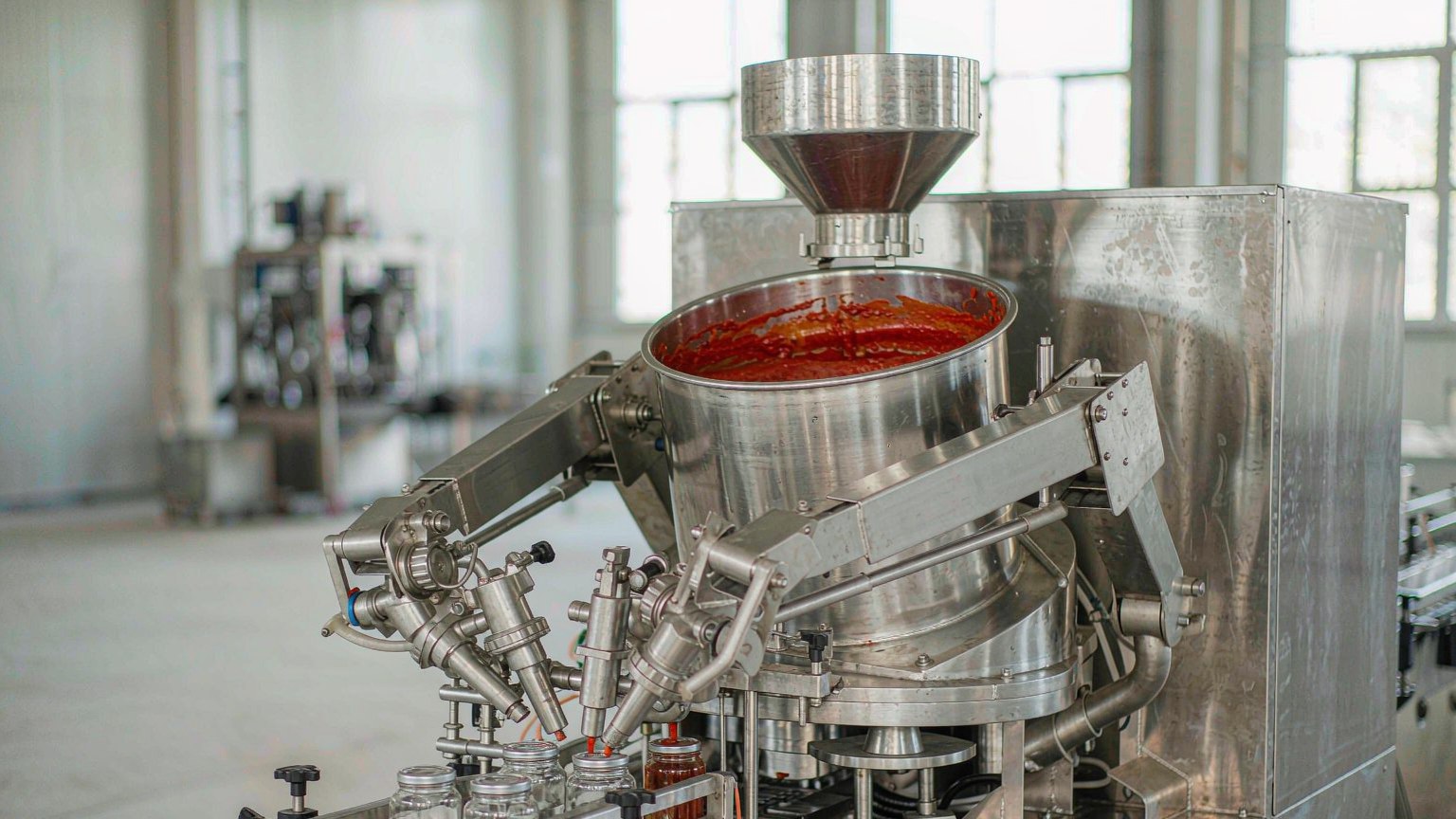
Paste filling appears across cosmetics, food, pharmaceuticals and chemicals, and in every one of those industries the pressure is the same: more output, tighter consistency, lower cost. An automatic paste filling machine answers that pressure by removing the operator from the dosing decision, and it is worth understanding how the subsystems divide the work.
The subsystems
The machine comprises a product tank, a transfer or conveying system, a metering device, the filling heads and a control system. Product is held in the tank and moved to the filling system by a pneumatic or electric pump; the transfer path is designed to avoid dead legs where viscous residue can collect. At the metering device, the dose is set — usually by a piston whose stroke is controlled precisely, or by a servo-driven screw whose rotation count defines the volume. The filling head then delivers that dose into a container presented by the conveying system, after which the container moves on to capping or sealing and labelling.
Why metering is the heart of it
Pastes do not behave like liquids. They resist flow, they are sensitive to temperature, and many are thixotropic, meaning their viscosity changes depending on how recently they were disturbed. A metering system based on a piston or a servo screw displaces a fixed volume mechanically, so it is less affected by those variations than a volumetric estimate would be, and it holds accuracy to a fraction of a percent. That precision is what protects both product cost and net-content compliance — and in pharmaceuticals and cosmetics, where the active ingredient is expensive, it is also a quality requirement rather than only a commercial one.
Automation and cleanability
Because the sequence runs under program control, an operator’s role shifts from filling containers to supervising a machine. That reduces the labour content per unit and, less obviously, removes the human variability that causes fill weights to drift through a shift. Many machines also include automatic cleaning routines, so that after production or a product change the internal product path can be flushed without a full manual strip-down — which addresses both changeover time and cross-contamination risk.
Flexibility and operator interface
Modern machines handle a range of container sizes and products by adjustment rather than by replacement of parts, which is what makes them suitable for multi-product, small-batch production. The interface is a touchscreen with a PLC behind it, so an operator sets or recalls parameters rather than adjusting mechanisms by hand. Data logging and remote monitoring extend this further, turning the machine into a source of production information as well as output.
What to weigh when choosing
Three questions separate machines that will perform from machines that will be tolerated. What filling accuracy is guaranteed, and at which container size? How long does a format or product change take, and does it require tools? And how is the product path cleaned, and how long does that take? A machine that answers all three well will be worth its price within a couple of years of normal production.
Need help specifying or upgrading a line?
Send us your product, format and target output per shift. We come back with a station sequence, the tooling list and an indicative price — no obligation.
