

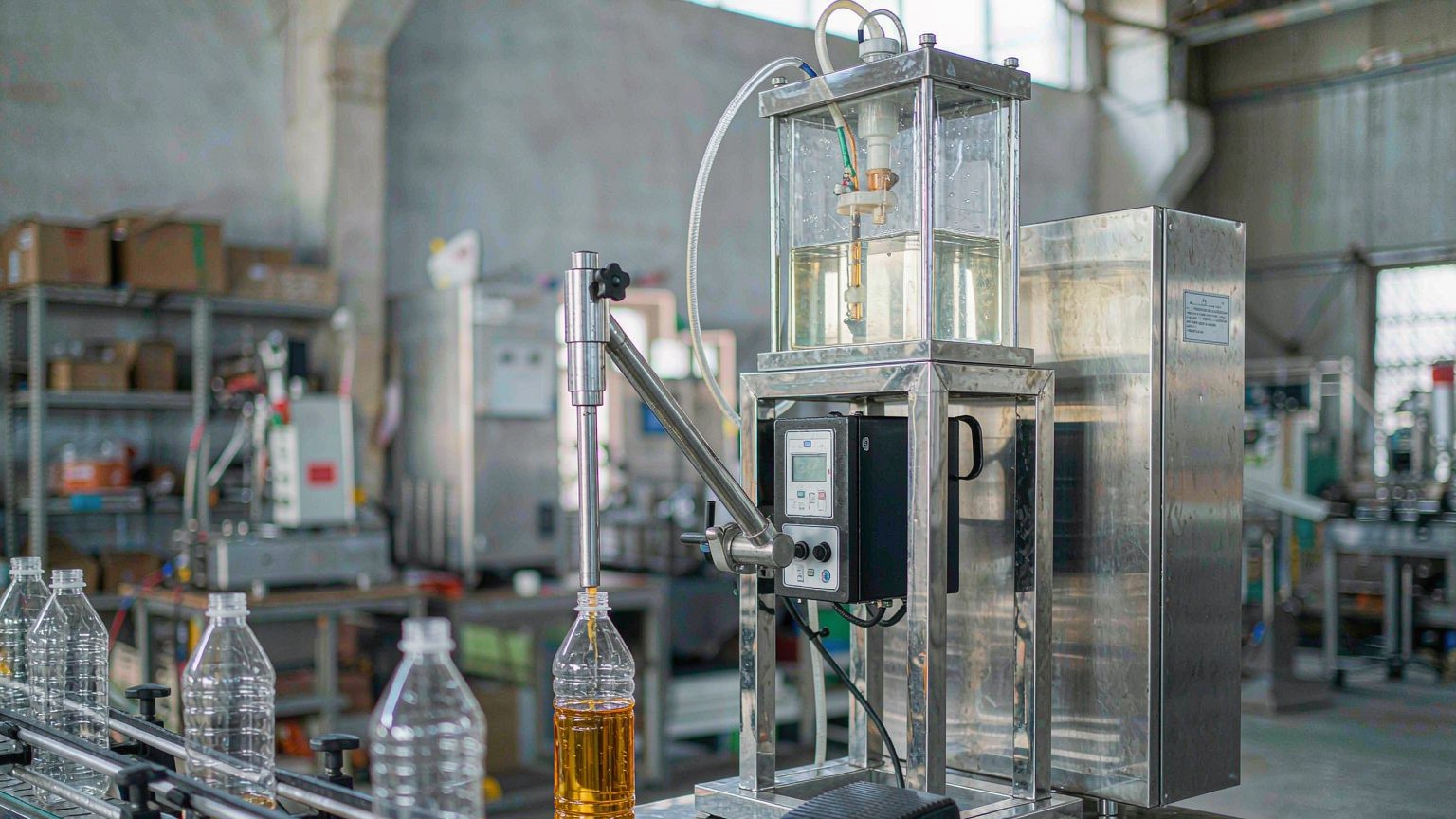
Laundry detergent looks like an easy liquid to fill and is not. It contains surfactants, and surfactants foam when they are poured. Foam in a filling line produces over-stated fill volumes, contamination around the bottle mouth and a closure that will not seal properly — which is why detergent filling technology is more specific than the product suggests.
The foam problem and how it is solved
The mechanism is straightforward: product agitated while entering the container entrains air, and in a surfactant solution that air does not disperse quickly. Three techniques address it. Low-level filling keeps the nozzle close to the rising liquid surface so the fall distance is short. Sub-surface filling goes further and places the nozzle below the surface, so product enters the body of liquid rather than the air above it. When the dose is complete, a suction or snuff-back action clears the nozzle so nothing drips onto the bottle mouth. Applied together, they hold the fill level stable and keep foam below the neck, which is what allows consistent high-accuracy filling across the large formats the category now uses — one litre, five litres and beyond — at production speed.
Closure: torque control where it counts
Detergent packaging is dominated by screw caps, with heat-sealed film used on some refill formats. Machines integrate cap unscrambling, cap placement and capping, and the capping station adjusts torque to the cap material and the sealing requirement. The requirement is two-sided: enough torque that the pack does not leak in a car boot or a warehouse, and not so much that the cap cracks or the customer cannot open it without a tool. The line then runs at thousands of bottles an hour, which is what makes the labour cost per unit tolerable in a category with thin margins.
The effect on packaging strategy
Reliable large-format filling made the refill pack mainstream. A five-litre refill uses a fraction of the plastic of five one-litre bottles, so the format aligns commercial interest with environmental pressure — and it only works if the filling is accurate enough that the refill is genuinely equivalent. At the same time, the machine’s tolerance for different bottle shapes means that differentiation no longer costs a new production line. Pump-topped, handle-carry and asymmetric bottle designs can all run on the same equipment, which gives brands freedom to vary pack design as a marketing decision rather than a manufacturing one.
Labour, and the reality behind it
The automation upgrade in this category is significant in labour terms: where a conventional line needed several people for bottle loading, filling, capping and inspection, a modern one with automatic unscrambling, in-line checkweighing and vision inspection runs with one or two. For a labour-intensive industry facing recruitment difficulty and high turnover, that is less a cost saving than a way of staying in production at all.
Need help specifying or upgrading a line?
Send us your product, format and target output per shift. We come back with a station sequence, the tooling list and an indicative price — no obligation.
