

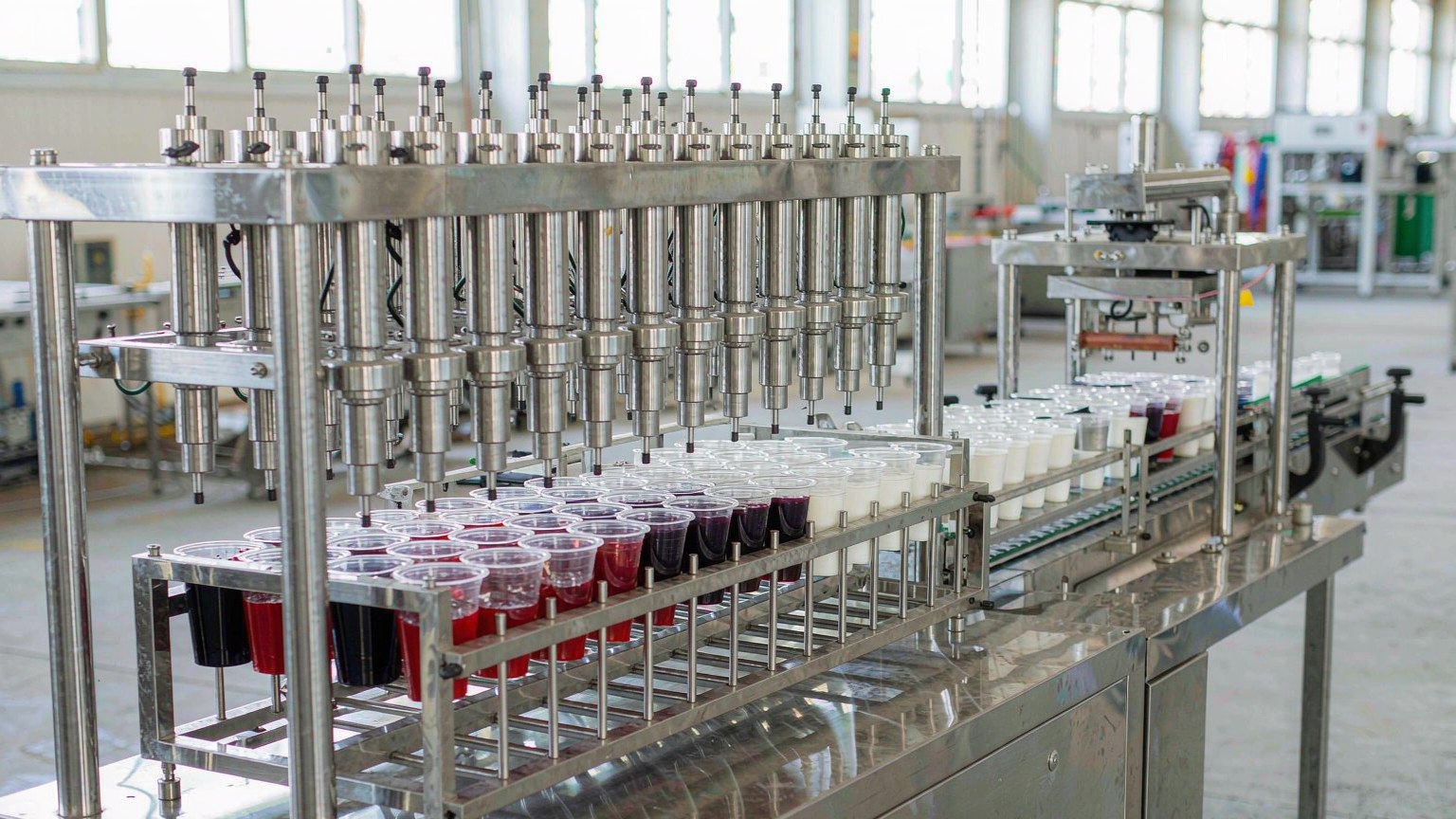
Ice cups are everywhere now — drinks shops, dessert counters, supermarket chillers, vending machines — and they all rely on the same underlying capability: packing a low-cost, perishable product accurately enough that it can be sold on a shelf. In this category, precision is not an engineering virtue. It is the product.
How an ice cup packer is built
The machine brings together a storage and transfer system, a filling system and a sealing system. The storage and transfer section holds the product and delivers a measured quantity to the filling area, which is straightforward for water and considerably less so for juice-based or semi-solid mixtures where the dose must remain constant from the first cup to the last. The filling system is the core: whether it meters by volume or by weight, it must be adjustable to the product and must deliver consistently rather than merely on average. Where the product contains fruit pieces, the design also has to prevent those pieces from bridging in the transfer path and stopping the flow.
Sealing, in step with filling
Filled cups move immediately to the sealing station. Heat sealing melts the lidding material so that it fuses to the cup rim; press sealing applies mechanical force to clamp a closure in place. Both must produce a bond strong enough to contain the product through transport and temperature change, and clean enough that the pack looks right on the shelf.
Why accuracy has a commercial value
Fill accuracy on a good machine is measured in fractions of a percent, and that matters most when the product is expensive. A consistent dose of high-value juice or a functional drink formulation means every unit delivers what was paid for, with no product given away in over-filled cups and no short weights to attract complaints. Consistent weight also makes the production cost predictable, which is what allows a price to be set with confidence.
Why the seal is inspected, not assumed
Seal position, force and completeness can all be controlled to a fine tolerance on modern equipment. Getting the position right keeps the pack aesthetically consistent; getting the force right is what allows the seal to be gas-tight without crushing the cup or thinning the film until it fails. The two failure modes sit on either side of a narrow window, which is exactly why the parameter is controlled rather than set once and forgotten.
Throughput as a market advantage
Modern machines fill tens to hundreds of cups per minute depending on configuration, using multi-head filling and fast transfer between stations to sustain the rate without idle time. In the summer peak, when orders arrive faster than plants can make them, that throughput is what decides which producer supplies the retailer — and it only counts if the accuracy has been maintained at speed.
Need help specifying or upgrading a line?
Send us your product, format and target output per shift. We come back with a station sequence, the tooling list and an indicative price — no obligation.
