

Answers to the questions our engineers are asked most often about machine selection, packaging materials, customization programmes and production support. If your question is not covered here, send it to us with your product details and we will answer it specifically.
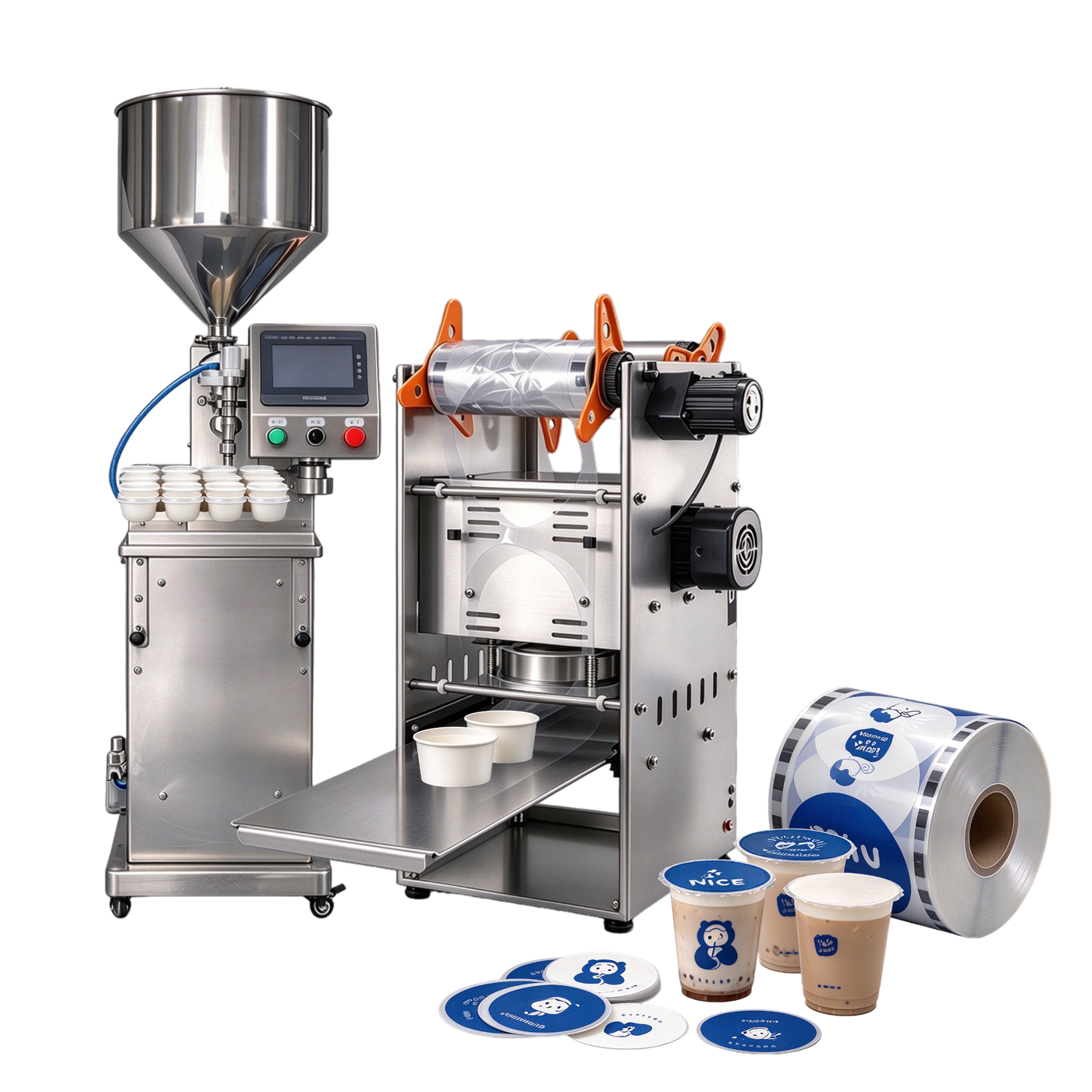
Choosing the Right Machine
What type of products can your machines package?
Our lines are configured across food, beverage, dairy, sauce, coffee and tea, ready meals, cosmetic and pharmaceutical products. The correct configuration depends on three things: the product's rheology and particle size, the container it goes into, and the shelf-life and hygiene class your market requires.
Where a product sits outside the usual range — very high viscosity, large particulates, extreme fill temperatures — we build a custom configuration instead of forcing a standard model.
How do I choose the right sealing machine?
Sealing selection follows the container, not the product alone. The decisive variables are container material, rim or flange geometry and tolerance, sealing method and film format, required output, and the seal window your product tolerates.
Start from the sealing machines range, then confirm rim dimensions with your container supplier before tooling is ordered. Rim tolerance is the most common cause of leaker rejects.
Automatic or semi-automatic — which is right for my volume?
As a working guide: semi-automatic suits 500–2,000 units per hour, single-product volume production suits automatic lines at 2,000–6,000 units per hour, and multi-lane high-speed lines serve 6,000–12,000 units per hour.
The practical constraint is usually labour and consistency rather than speed alone. If you need identical seal quality every cycle with minimal operator judgement, automation pays for itself earlier than the volume figures suggest.
How do I choose a filling machine?
Filling selection is driven by viscosity and accuracy requirement. Low-viscosity liquids suit gravity or flow-meter filling; thick pastes and creams suit piston or gear-pump; powders and granules suit auger or volumetric cup filling.
See the filling machines range for the four main families. If your product bridges — for example a sauce with particulates — tell us, because that changes the nozzle and pump selection.
Can one machine handle several different products or container sizes?
Yes, within a defined range. Changeover is handled through tooling sets and recipe recall on the HMI, so fill volume, seal temperature and cycle timing adjust without mechanical recalibration.
The practical limit is container nesting geometry: a machine configured for 75 mm cups cannot be changed to 150 mm without a different tooling set and often a different film path. Send us your SKU list and we will tell you how many tooling sets you need.
Packaging Materials & Films
Can you provide packaging containers?
Yes. We supply cups, containers, trays and boxes across PP, PET, paper, CPET, APET and aluminium formats, and we support custom container development where a standard format does not fit.
Containers are specified together with the machine, not separately, because rim geometry and material grade determine how the seal performs. See the packaging materials range.
Can you provide sealing film?
Yes. We supply clear, printed, peelable, anti-fog and high-barrier films, and we match the sealant layer to your container material so the seal bonds reliably.
Film selection depends on container material, sealing temperature window, product sensitivity, required shelf life and your machine's web path. We validate the structure on production samples before you commit to a run. See sealing films.
How much does packaging material affect shelf life?
Often more than the machine does. Once a seal is sound, shelf life is usually limited by the barrier of the film and container structure — specifically oxygen and moisture transmission.
For that reason we recommend fixing the product, storage temperature and shelf-life target first, then selecting the film structure. Choosing the film first tends to lead to either over-specified cost or an unmet shelf-life target.
What is the difference between MAP, vacuum and skin-pack?
Each solves a different problem. MAP replaces headspace oxygen with a controlled gas mix to slow oxidation and microbial growth — the standard for chilled ready meals. Vacuum removes air entirely and suits frozen and dry formats. Skin pack forms the film tightly against the product surface, holding it in place and reducing visible air for premium presentation.
Can I use my own containers and films with your machines?
Usually yes, subject to compatibility. We review your container drawing and film specification against the machine's sealing nest, film path and seal window, then run a validation trial.
Where a mismatch appears — commonly rim tolerance, film sealant chemistry or web width — we will say so before the order rather than after installation.
Customization & OEM / ODM
Can you customize the machine?
Yes. Custom configurations can be developed around product characteristics, container size, fill volume, sealing diameter, production capacity, automation level, integration with existing lines and specific hygiene or documentation requirements.
Most custom machines are built on a validated platform, which keeps the mechanics proven while the tooling, dosing and interface are engineered to your requirement. See custom machines.
Can you provide a complete packaging solution — machine plus materials?
Yes. We combine filling equipment, sealing equipment, containers and sealing films into one specification with a single point of accountability for performance.
This matters most where the seal is the failure point: if the machine and the film come from different suppliers, responsibility for a leaker tends to be contested. With one specification, the performance obligation sits in one place.
Do you offer OEM and ODM manufacturing?
Yes. In an OEM engagement you define the product and specification and we build under your brand. In an ODM engagement you define the market need and we develop, specify and manufacture under your brand.
Both operate under NDA with staged production from pilot batch to series. See OEM / ODM.
Can you print our brand on the sealing film?
Yes. Printed, print-registered lidding films are available in up to eight colours, with the print registered to the seal area and container geometry so branding stays aligned after sealing.
Registration tolerance is typically held to ±0.3 mm. See custom printed films.
Production, Delivery & Support
What production capacity can you support?
From roughly 500 units per hour on semi-automatic equipment through to 12,000 units per hour on multi-lane automatic lines. The practical upper bound depends on the container format, the number of components filled and the pack-handling stages either side of the sealer.
What are typical lead times?
Standard machines typically ship in 6–12 weeks. Custom machines and full lines typically run 6–24 weeks depending on design scope and tooling.
Tooling for a new container format adds time and should be planned in the first conversation. We will give you a stage-by-stage schedule at quotation rather than a single figure.
Do you install and commission on site?
Yes. Installation, commissioning and operator training are included in line supply, and we conduct a factory acceptance test before shipment so the line is proven before it leaves our facility.
What support is available after installation?
We provide spare-parts supply, preventive maintenance schedules and technical escalation. Consumable specifications — film and container — are held on record so repeat orders match the validated configuration.
Our team can also review line performance after commissioning and recommend optimisation if throughput or reject rates drift from the acceptance figures.
How do I get a quotation?
Send us the product you are packing, the container you intend to use, your target output and your destination market. Photographs or a product sample help considerably.
The more of those inputs you provide, the more precise the proposal — and the fewer assumptions we have to make. Use the contact form or the buying guides if you are still defining the requirement.
Still Have a Question?
Send us your product, container and production target. Our engineers will answer with specifics rather than generalities — and tell you plainly when a standard machine is not the right answer.